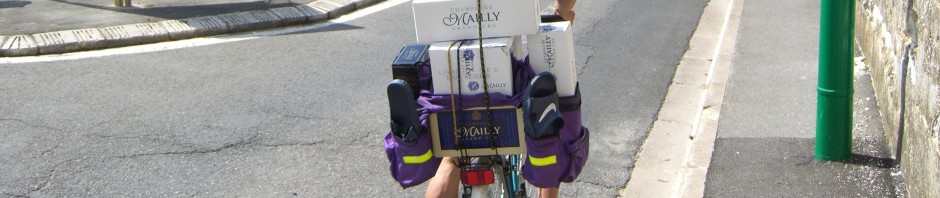
It is Wednesday again and it is time for another installment of Wine Trivia Wednesday. Before we get to this week’s quiz, we need to get to the answers from last week. The last few weeks, the focus has been on Champagne. As I mentioned a few weeks ago, this summer I will be heading to the region to lead a bike trip as a Tour Guide with Blue Marble Travel (be sure to go check them out, it is a fun company). I am very excited about the trip–even excited to drink Belgian beers.
This week, once again, there was exactly one winner. He won by default, though, since he was the sole respondent. Nonetheless, kudos to Talk-a-Vino for getting two out of the three correct.
- What does “RM” on a bottle of Champagne mean? As Talk-a-Vino correctly pointed out, it stands for “Récoltant/Manipulant”, which basically means that they grow their own grapes and make their own champagne. It is an increasingly popular category of champagne these days.
- Most people know that the Champagne is made from the blending of three grape varieties (there are others, but they are close to insignificant). Occasionally, Champagne is made from just one of these three–which of the “big three” most rarely “stands alone” in the bottle? The correct answer here is actually Pinot Noir, surprisingly. A Blanc de Noirs (“White from Blacks”) is a rather rare bottling in Champagne in general compared to the Blanc de Blancs (“White from Whites”). A 100% Pinot Meunier (which is technically a Blanc de Noirs but is rarely labeled that way) is fairly common in the Vallée de la Marne which contains countless growers that often bottle their own champagne. Sadly, these 100% Pinot Meuniers rarely make it to the export market.
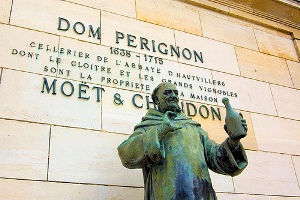
- What house produces the most bottles of Champagne annually? Can you also name #2 and #3? Talk-a-Vino nailed this one on the head as well–Moët et Chandon (makers of Dom Pérignon, below) is comfortably #1 followed by the still trendy Veuve Clicquot and (somewhat surprisingly) the cooperative, Nicolas Feuillatte.
On to this week’s quiz. I have been re-reading Richard Juhlin’s fantastic book, 4000 Champagnes, which is an absolutely fantastic resource for Champagne, but it is also loaded with great information about wine in genera. Here are a few questions I derived from the book:
1) True or False: Malolactic Fermentation raises the overall acidity level of a wine.
2) Which of the following Champagne Houses commonly use oak in the production of their champagnes?
a) Veuve Clicquot
b) Krug
c) Moêt et Chandon
d) Bollinger
e) Gosset
3) Oxidized wines can best be described as:
a) smelling like a musty basement
b) smelling and tasting like Sherry
c) have the odor of a barnyard
d) tasting overly jammy
Have fun with the quiz–answers next week!
And don’t forget to vote in the Wine Blog Awards for the Drunken Cyclist (click on the badge below to vote).







 the drunken cyclist
1) Pretty sure it reduces acidity… though this could be a trick question where it is equal malic and lactic acid in the process. I am going with reduction.
2) Krug.uses barrels.
3) smelling and tasting like sherry.
LikeLike
Thanks for playing! Answers Wednesday!
LikeLike
I fear question one may be a trick (one acid converts to another and this ‘softens’ the acids, but as for increase/decrease?). As far as question two goes, I am not sure about ‘commonly’, but here goes:
1) false
2) b, d, e
3) b
LikeLike
Great answers! Answers Wednesday….
LikeLike
not sure about the total acidtiy, but i know the pH goes up after ML, so I am going to guess that the total acidity goes down
LikeLike
Thanks for the input Gabe!
LikeLike