Like it seems with most of the planet, Houston has been unbearably hot the last month or so. Luckily for me, I am gone for most of the month of August, bouncing around Europe a bit.
Before I left, I tried to organize the home office a bit, which almost always means getting the samples pile under control. To that end, I decided to blaze through a few of the cans that have accumulated.
While canned wine is certainly far from the norm, more wineries are experimenting with the format. It is still up in the air, however, if cans are better for the environment than glass:
- Producing glass requires one tenth the energy than cans from virgin aluminum.
- But, producing cans from recycled aluminum takes half the energy of glass.
- It is much easier to recycle cans than glass.
- Cans require far less energy to ship as they are much lighter than glass.
The biggest problem, at least as I see it right now, wineries that do use aluminum cans are not putting very good wine into them. Thus, when (if) a consumer tries a canned wine, the chances are pretty good that they are drinking a rather mediocre product. The result is the consumer tends to think that canned wine = crappy wine.
So until wineries start making a commitment to putting better wine in lighter packaging, I am afraid there won’t be much of a movement toward cans.
Regardless, on a sweltering afternoon in Houston, I sat down and tried the following canned wines (and one cider).
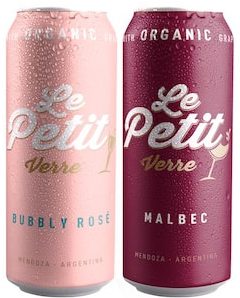 NV Domaine Bousquet Le Petit Verre Malbec, Mendoza, Argentina: Retail $17 (4x250ml cans). I really have no idea when these cans hit my doorstep, but they arrived in pretty rough shape: the box, that contained the four cans was beat to hell and the cans were also fairly dinged up. But here I am, I have no idea how many weeks, months, years (?) later, cracking these suckers open for a taste. You know what? The Malbec is not half bad. In fact, I would assert with some confidence, that it is actually pretty good. A bit of sulfur on the nose, but otherwise good dark fruit and a bit of spice. The palate is fruity and balanced, a pretty solid quaff. Very Good. 88 Points.
NV Domaine Bousquet Le Petit Verre, Sparkling Rosé, Mendoza, Argentina: Retail $17 (4x250ml cans). 50% Pinot Noir, 30% Syrah, 10% Pinot Gris, 10% Viognier. As I mentioned in the above note, I am not sure when I got these cans, but it has been a while. Even a long while. But I was cleaning out the office before my trip and these needed to go. The Malbec was good, even Very Good, but this sparkler? Maybe it was affected by the delivery–the box was in rough shape as were the individual cans (if you are going to offer wines in cans, you better come up with a better delivery system). But the Malbecs were OK, so… Quite a bit of sulfur on the nose. So much so that it was impossible to pick up anything else. The palate was better although the sparkle was slight, I am wondering if this was affected by the journey. Not Rated.
 2021 Lucky Rock Wine Co. Sauvignon Blanc Country Cuvee, Sonoma County, CA: Retail $40 (6 x 250ml cans). Once again, I am not entirely sure when this can landed on my doorstep or if it is the same as the 750ml bottle I reviewed a few months ago (91 points). As I have found with most cans I have tried recently, there seems to be much more sulfur added than what I find in bottles, at least that seems to be the case on the nose of all these wines. Decent fruit on the palate, with a nice acidity as well, but that sulfur component also comes through here. I really want to embrace the movement to lighter, more environmental packaging (although the jury is still out if cans are better than glass), but if cans mean a whole lot more sulfur on these wines, I am not sure that is a tradeoff I am willing to make. Good. 86 Points.
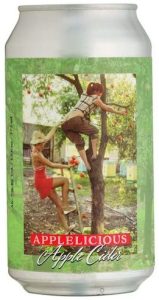 2021 Tongue Dancer Applelicious, Sonoma County, CA: Retail $6 (375ml can). 7% alcohol. Gravenstein and Golden Delicious apples. Champagne yeast. I have next to zero experience with cider. In fact, the only time I ever drink it is when I am at my favorite creperie in Paris. Yeah, I am that pretentious. I do have a bit of experience with Tongue Dancer Wines, however, and I am confident that James and Kerry would not put forth a product that was not “amazeballs” (I am pretty sure I borrowed that term from Kerry). Some slight funk on the nose, but pure joy on the palate, just a hint of sweetness and plenty of verve, this is close to the perfect antidote for this Houston afternoon, which currently sits at 103°F. Again, quite new to the cider thing, but this is stellar. Outstanding. 95 Points.
 2022 Underwood Pride Rosé, Oregon: Retail $7/375ml can. 77% Pinot Gris, 15% Muscat, 7% Pinot Noir, 1% Chardonnay. I am not sure if this is the same blend that goes into the bottled rosé (which I really liked for the 7th Annual World’s Largest Blind Tasting of American True Rosé), but I also like this canned wine, just not quite as much. Bubblegum pink in the glass with strawberry, cherry, melon, and even some red delicious apple. The palate is fruity, zingy, and with just a hint of sweetness (4.84 g/l). A lengthy finish, characterized by a pink bubblegum note, adds interest. Very Good. 89 Points.





 the drunken cyclist