Even though I have never met the kind folks at Domaine Bousquet in person (although that might change in November), it seems as though they are certainly producing wine the “right” way. They make highly affordable, tasty wines from organically grown grapes. I have, however, “met” Anne Bousquet via Zoom and all of that interaction only underscored my previous assertion.
But.
 Regular readers of this space know that I take issue with overly heavy bottles. As I have stated countless times before, the additional weight serves absolutely no purpose when it comes to still wine (I will address the heaviness of sparkling wine bottles below, kind of).
That additional weight, however, is more costly to produce and much more costly to transport. When you multiply the number of times that additional weight is transported, the carbon footprint of the wine skyrockets.
Therefore I struggle with why a winery that is so consumer friendly and, more to the point, dedicated to producing more planet-friendly wines, continues to use such environmentally damaging packaging.
A marketing person that I really admire once told me that the heavier bottles were to help to promote sales; consumers consider heavier bottles as a sign of quality. While I do not dispute that might be the case, I would contend that if you need heavy bottles to convince people to buy your wine, you might need to consider replacing your sales force.
Another pet peeve of mine is the use of foil to cover the tops of the bottles. It serves no modern purpose and only ends up in a landfill somewhere. (Originally, the foils were added to prevent vermin from eating at the cork in the cellar. If that is your concern, you have much bigger problems to worry about.)

Rip it off, throw it in the trash.
Again, I really love what the folks at Domaine Bousquet are doing; the wines are fabulous and the commitment to organic fruit is laudable, but I hope they reconsider their packaging.
 2020 Domaine Bousquet Cabernet Sauvignon Gran Vino Orgánico Anne Bousquet, Tupangato, Mendoza, Argentina: Retail $18. Heavy Bottle. DIAM5. 100% Cabernet Sauvignon. I know I sound like a broken record, but I don’t care; we just had the hottest July on record, August is trying to keep pace, and it is going to get worse. Will ditching heavy wine bottles for more environmentally responsible lighter ones make any difference? It might be too late, but I am pretty sure many little decisions add up to big ones. For a winery that proudly (as it should) declares on every bottle that they use organic fruit, the decision to use these stupid bottles still baffles me. As for the wine, like most in the DB portfolio, is an incredible bargain: dark red and black fruit in the glass (plum, blackberry, cassis), with subtle vanilla and oak, and some dark spice. A wonderful nose. On the palate, there is an intense wave of rich fruit which eventually leads the way to a zingy tartness on the mid-palate. Some subtle, silky tannins peek out on the finish, but make no mistake, this wine is ready now. Again, a fabulous value. Excellent. 92 Points.
 2022 Domaine Bousquet Malbec Nouveau Gaia, Tupangato, Mendoza, Argentina: Retail $20. Heavy bottle. DIAM5 closure. 100% Malbec. In the above note, I railed against the fact that this organic house uses really heavy bottles for some of its wines. Here, I will mention that DB still uses foils on all of their non-twist-off wines (I think), which, as they undoubtedly know, serves no purpose other than eventually ending up in a landfill somewhere. As for the wine? I believe this is my first carbonic Malbec and it is a delight: joyous fruit (as one would expect) with that characteristic bubblegum aspect that I associate with “Nouveau” wines. The palate adds some spice, but the story here is all that fruit and the accompanying acidity. Excellent. 91 Points.
 2021 Domaine Bousquet Pinot Noir Reserve, Tupangato, Mendoza, Argentina: Retail $18. Heavy Bottle. DIAM5 closure. I really admire Domaine Bousquet’s commitment to producing wines from organically grown grapes, but I am puzzled as to why they continue to use unnecessarily heavy bottles for many of their wines. I am no environmental scientist, but I would guess any good done to the planet from their farming practices is offset by the carbon footprint of these bottles. As for the wine? It is quite good, even excellent; a practically clear light ruby in the glass with dark cherry marmalade, Asian five-spice, and just a touch of vanilla. The palate is, well, wonderful, which is surprising for a Pinot at this price: great fruit, wonderfully balanced with a subtle zinginess, all followed by a lengthy finish. Very nice. Excellent. 91 Points.
The next two wines are in delightfully light bottles, so I know that they know it is possible.
NV Domaine Bousquet Chardonnay Lo Ca, Valle de Uco, Mendoza, Argentina: Retail $15. Under screw cap. 100% Chardonnay. This represents the first foray into low-calorie wine for Domaine Bousquet (and for me, for that matter). The wine boasts only 75 calories for a 5-ounce pour, about 25% less than standard wine (and at 9% alcohol, it is less in that arena as well). As far as I could ascertain, the lower alcohol is derived through ripening and picking decisions, not through manipulation in the winery. Pale straw in the glass with plenty of citrus and tree fruit on the nose. Quite tart on the palate, as one might expect (when one picks for lower alcohol as an end result, the fruit would have to be harvested at a lower sugar level, which also means higher acidity) and it comes off as much more Sauvignon Blanc-like, at least to me. That is not a bad thing in any way, but those looking for a creamy Chard will not find it here. Look, I am not sure how much lasting power lo-cal wines will have (if any), but this is a nice entry into the space. Very Good. 89 Points.
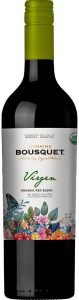 2021 Domaine Bousquet Virgen Red Blend, Tupangato, Mendoza, Argentina: Retail $14. 35% Malbec, 35% Cabernet Sauvignon, 30% Cabernet Franc. Under screw cap. Medium to dark crimson in the glass with intense red and black fruit aromas: plum, blackberry, cassis, cherry. Toss in some vanilla and herbs (mint, basil) and the nose certainly has a ton going on. The palate is all about the fruit as well (and a little bit of heat), particularly initially, followed by ample acidity (which tries its best not to get lost in all that fruit), a bit of spice, and an above-average finish. A solid wine in the price point. Very Good. 88 Points.
Here is where I have a personal dilemma: I love sparkling wine, particularly champagne, but the bottles are easily the heaviest on the market. There is a good reason for that: most sparkling wines have an internal pressure of 5-8 bar (about 75-120 psi or roughly the same as a road bike tire) and lighter glass would likely explode. And no one wants that. So what to do? The folks in Champagne are working on a lighter glass, but it is only about 20% lighter. Stay tuned…
 NV Domaine Bousquet Brut Rosé, Mendoza, Argentina: Retail $13. 75% Pinot Noir, 25% Chardonnay. Organic grapes. Charmat method. It has been a few years since I sampled this sparkler from one of my favorite producers in Argentina. Not only are they making their wines with a conscious eye to the environment, but they also have a wonderful outreach program for tiny bloggers like me. The wine is as I remember it, fruity (with strawberry, cherry, and also a touch of rhubarb), has a vibrant sparkle, and just the slightest hint of sweetness (8.2 g/l). It finishes long and, again, fruity, and is a lovely quaff on another sweltering day here in Houston. Very Good. 88 Points.







 the drunken cyclist
Thank you for continuing to call out needlessly heavy bottles and wasteful foil toppers. I applaud the wineries that have already moved on to more sustainable and economic packaging.
LikeLike