For those who know me, I have an aversion to hyperbole. I tend to lead my life down the middle, clinging (for the most part) to convention, and avoiding the slick “trends”. But a few weeks ago I received a press release in my email inbox that caused me to get really excited.
Keep in mind that I get hundreds of emails a day and at least two-thirds of them are some sort of press release. The majority of them have to do with wine or cycling, of course, but there are also some really odd ones (Swamp Butt Underwear and the National Axe Throwing Championships come to mind).
Normally, I just glance at the subject line, delete, and move on, but this one quickly caught my eye. First, it was sent by a public relations professional that I know and respect and second, it touched on a subject that is very much close to my heart.
So what was this email that almost brought me to tears?
“Wine News: New $160 Boxed Cabernet from My Favorite Neighbor”
While that might not be a line that brings much excitement to many (most? any?) people, I have been concerned about the excessive waste in wine packaging: heavy glass, wasteful closures such as foil or wax, and cardboard gift boxes. All of which contributes to more carbon emissions and usually just end up in a landfill.
Yeah, I am pretty fun at parties.
I have long thought that the wine industry, which is likely more affected by climate change than almost any other, needed to be at the forefront of developing new and more sustainable packaging materials.
So when I saw that My Favorite Neighbor (MFN), the second label of Booker Wines (a Paso Robles producer that has achieved near cult status), was going to put its $55/bottle wine into three-liter boxes, I had to get one and try it out. What made it all the more interesting, perhaps, is that Booker and MFN are now owned by Constellation Brands, one of the larger wine conglomerates in the U.S.
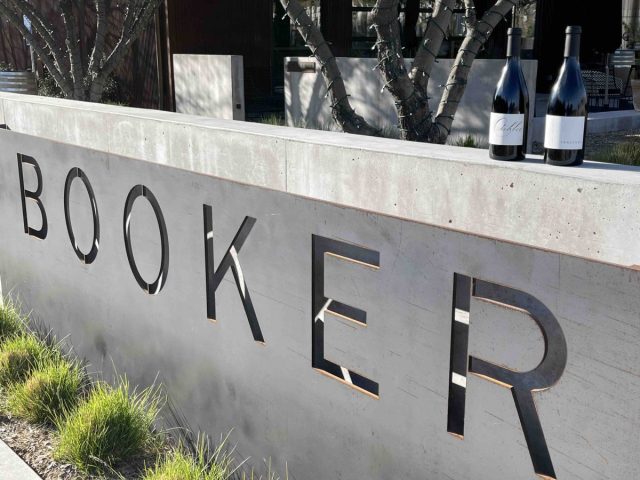
This trip included my first stop at Booker. Incredible wines.
Why is that “more interesting”? Well, it has been my experience that the wine industry as a whole is resistant to change, and for a large corporation like Constellation to take such a step seems like a big deal to me. Sure, they only produced 300 such boxes of the MFN Cabernet, but in my mind, any step at this point that challenges traditional thinking is a big step in the right direction.
Boxed wine has long been seen as cheap, mass-produced, and utterly disinteresting by “serious” wine folk so if a major corporation and a respected brand can take this step with an eye (perhaps) of changing perception for the betterment of the planet? I am all for it. The MFN Cabernet Sauvignon box retails for $160 and contains the equivalent of four 750ml bottles (which normally retail for $55 each).

The carbon output of the box is one-eighth of the equivalent of four bottles. (The scale reads 2978 grams, not sure what happened there.)
Naturally, I reached out to get a box as well as ask a few questions, which were graciously answered by Pete Turrone, director of winemaking at Booker and MFN.
- Whose idea was it to box up MFN? Was Eric (Jensen, founder and original winemaker at Booker, MFN) involved or was this solely a Constellation decision?
It was a collective decision by the MFN team, which of course includes Eric. We’re always casting about for new ways to build upon Eric’s core ethics of sustainability and environmental stewardship. These types of things always start with a “What if…” And sometimes that question leads us to something new like this. Eric has farmed the estate organically practically since day one, the vineyard is now certified organic and likely soon to be certified regenerative. The winery is solar-powered. The wines are free of additives. MFN boxed is another step in this journey.
- I think you told me that there were only 300 boxes produced? Any indication on how sales have gone?
Yes, 300 boxes produced. We never want to force our customers into anything they don’t want, instead, we are inviting them to take a journey with us towards a brighter future. Considering the nature of this gentle invitation, the sales have been impressive.
- Any feedback from customers at this point? Was the target home consumers or perhaps BTG (by the glass) on-premise programs?
The target is home consumers. Great feedback from customers! It’s wonderful to see them demonstrating their support for and appreciation of this program’s environmental initiative. A few customers have mentioned that they are happy to see MFN go beyond buzzwords like sustainability and live up to our promises in continuing to push ourselves to find new ways even outside of the vineyard to minimize our carbon footprint.
- Was this solely a “better for the environment” move or do you see some other benefits?
It’s both. From a consumer perspective not only is it better for the environment, but it is cost-effective, and they can enjoy the wine more conveniently with how well the box protects the wine after opening. Passing the packaging savings on to the consumer is our way of rewarding them for making the greener choice.
- Is this a “wait and see how it does” or is there a commitment to providing at least MFN in this format for future vintages?
We will always meet our customer demands for environmentally responsible packaging in every way we can.
- Most info I have seen states that the wine can last at least 3-6 months upon opening. Is that consistent with what Booker/MFN is recommending?
We recommend consuming within two weeks to a month after opening. But I would be surprised if it lasts that long after tasting how good it is!
Of course, all that is fine and dandy, but is the wine any good? In a word: Whoa.
2021 My Favorite Neighbor Cabernet Sauvignon, San Luis Obispo County, CA: Retail $55. Sampled from 3L box, $160. 83% Cabernet Sauvignon, 7% Petit Verdot, 7% Malbec, 2% Petite Sirah, 1% Syrah, aged for 18 months in 55 percent new French oak barrels. Fairly dark in the glass with a particularly remarkable nose of brambly fruit (blackberry, boysenberry, black cherry, and black current–yeah, a lot of black), Christmas spice (cinnamon, clove, allspice), a touch of black earth, an herbal hint (basil, thyme), and a heaping soup spoon of verve. Whoa. The fruit takes control initially past the teeth but in a unified “red and black berry fruit salad” kind of way as the focus quickly shifts to the acidity. Whoa, Nellie. Tart, but not biting, zingy, but not showy, and linear but not excluding, the backbone of this wine is pretty remarkable. On the midpalate, there is the spice (clove), and the herbal (basil) really kicks in and we see the first evidence of tannin. The Finish? For days. The fruit and the tartness start the show and stay through the final number, but that hint of tannin on the midpalate comes in before the finale and has a presence. It is not a scene-stealer as the tannins are relatively soft and integrated, but they do hint that this wine has more life than the shelf-life might suggest. Yeah. Whoa. Outstanding. 94 Points.
The only problem, yes only problem I have with this wine, this box, this approach? It is really difficult, nay, impossible, to know with any certainty how much wine is left in the box. Until it is too late.







 the drunken cyclist