Over the course of a week, I taste a bunch of wine, usually with friends, and almost always with my wife. Here are some of the wines we tasted over the past few weeks. These are wines that were not sent as samples—in most cases, I actually paid for these wines (although a few have been given as gifts).
NV Herbert Beaufort Champagne Grand Cru Carte d’Or Tradition Brut, France: Retail $50. 90% Pinot Noir, 10% Chardonnay. Well, this is the end of the line with this wine. I bought a case of this wine from the antiquated Pennsylvania Liquor Control Board on my way out of Philly for the last time. This go around, the first in several years, this iteration is incredibly rich, perhaps richer than the others. Incredibly yeasty on the nose with hints of lemon rind and lime. The palate is rich and layered with freshly baked baguette, citrus tartness, and a lengthy finish. Whoa. Bouzy is one of my favorite towns in Champagne and I still love the richness and gusto that come with a Pinot dominant champagne. Outstanding. And farewell to this wine. At least for now. Outstanding. 94 Points.
2006 Blain-Gagnard Chassagne-Montrachet 1er Cru Les Caillerets, Burgundy, France: Retail $125(?). Under cork. I bought this on a bit of a whim however many years ago and when I popped the first cork of my three bottles? I thought it was certainly “very good” but it was missing that “older” white Burgundy vibe. It was a bit golden in the glass with a slightly oxidized nose and practically devoid of fruit. The palate? An entirely different vibe going on as the well nose as the aformentioned fruit comes in quickly. It is pretty clear that I may have waited too long to pop these corks as this wine, too, is slightly oxidized in color with much more of a “dessert wine” than of the “world’s best” region for Chardonnay. The palate confirms this assessment as there is fruit, yes, but the palate is dominated by the oxidative note (it is subtle, however). Still? A fun, quaffable C-M, but this wine should be much more than that. Very Good. 88 Points.
NV Pascal Doquet Champagne Premier Cru Arpège Blanc de Blancs, France: Retail $70. 100% Chardonnay. Bottled 2013, disgorged October 2017 (I have said it 1000 times: all champagnes need to include disgorgement dates). A few years ago, my wife purchased this for me for my birthday and since we did not drink it that night, I did what I always do: I put it in the cellar and forgot about it. Good thing. It now has a bit more age on it (as exhibited by the non-expanding cork), which is evident by the color (on the verge of golden), the nose (slightly oxidative), and the palate (gloriously toasty and nutty). I have long held that I prefer Pinot Noir-dominant champagnes as I find them more vinous, with more body, and more backbone. But. In recent years, I have come around to the Blanc de Blancs style, particularly when the wine has some age on it. Those wines tend to have a bit more of the autolytic, yeasty component that I just can’t taste enough. Outstanding. 94 Points.
NV Gloria Ferrer Blanc de Noirs Rosé, Carneros, CA: Retail $25. 90% Pinot Noir, 10% Chardonnay. I really liked this wine in the 4th (92pts) and 5th (93pts) World’s Largest Blind Tasting of American Sparkling Wine, and hope to include it again this year (fingers crossed). What I wrote last year: “Really light in color, barely a rosé. Floral, fruity, but also shy. Another lovely wine on the palate. Holy cow: great balance between the fruit and acidity, the right amount of dosage.” Pretty close to this bottle. Excellent. 92 Points.
2020 Out East Côtes de Provence Rosé, France: Retail $40. 70% Grenache, 30% Cinsault. Most people cringe when they see a rosé that is more than a heartbeat old, but I embrace “older” rosés, even seek them out, particularly if it is a True Rosé like this one. I found this online for $12 and even though it was a couple of years past release, I took a leap. Given that this is a True Rosé, it should continue to evolve for another couple of years at least. A bit darker than your average Provençal rosé with a lovely nose of wild strawberry, white peach, and Bing cherry. The palate is quite fruity but with a tartness to match but also considerable roundness and weight. While this is by no means “big” it is certainly “bigger” than most wines from the region, as it is no doubt intended for the American market. Very Good. 89 Points.
2007 Siduri Pinot Noir Clos Pepe Vineyard, Sea Rita Hills, CA: Retail $65. I was in the midst of a quick (?) inventory of my cellar and I “discovered that way too many bottles were “missing”. But there is almost always a bright side as I “find” a few bottles that I thought had been consumed. Such was the case here; this bottle was nowhere to be found in my records, and therefore was a “free” bottle. Hallelujah! Well, Clos Pepe is hallowed ground to me and Siduri is one of the brands that lured me into this whole “wine thing” so I felt like I was playing with house money. And I was. Dark in the glass–much darker than any Pinot should aspire to be with dark, almost stewed blackberry and cassis fruit. Again, strange for a Pinot. But Clos Pepe is no ordinary vineyard and Adam Lee is no hum-drum winemaker. Rich, layered, and tart, this wine, while by no means “huge” is certainly “big” with intense fruit and an incredible depth. Yes, this is a 16-year-old Pinot and yes, this is certainly on the “big” side of the variety. But it is also incredibly well-balanced and tasty. Bravo to both Adam and Wes Hagen, former vineyard manager of Clos Pepe. Outstanding. 94 Points.
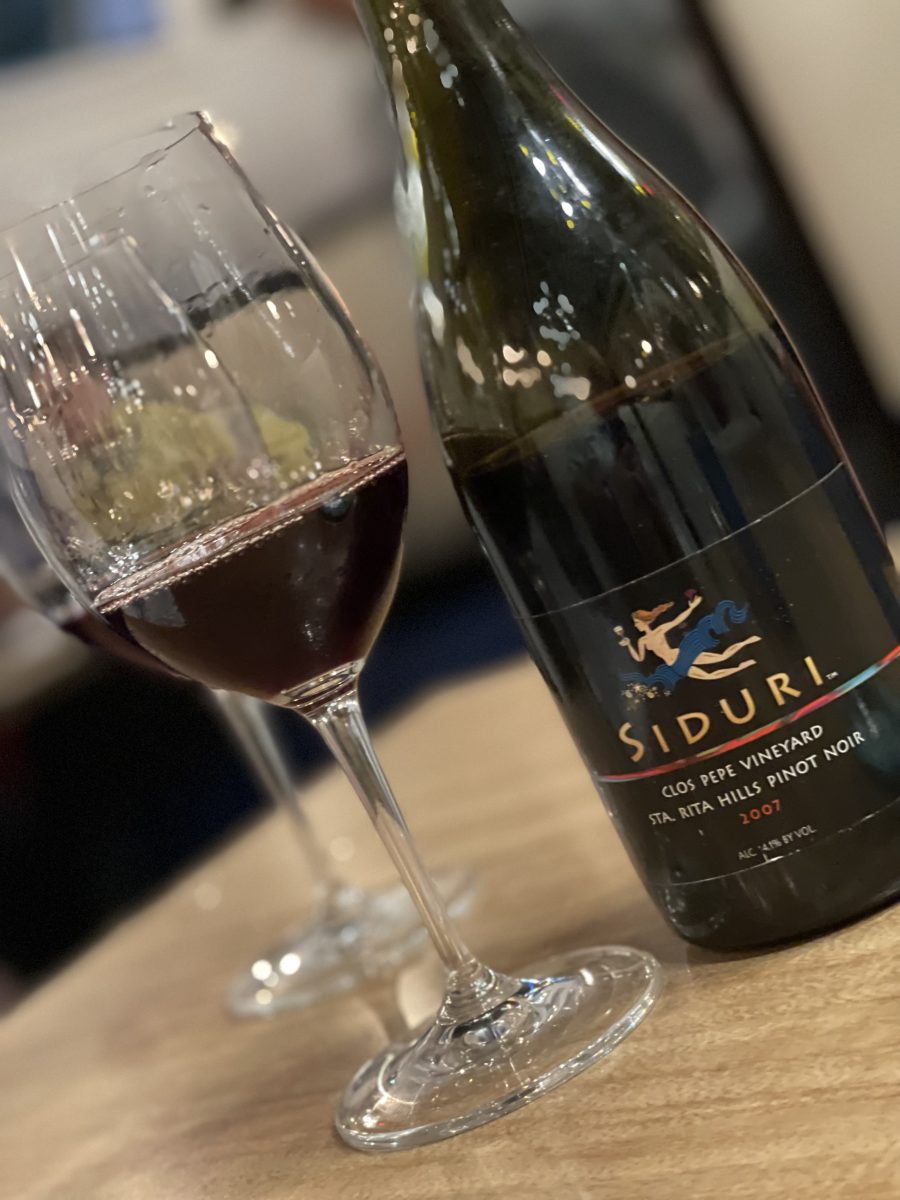
WINE OF THE WEEK: For the first time in a long time, I really struggled with selecting the Wine of the Week. On the one hand, there was the Herbert Beaufort Carte d’Or Champagne which was one of the best purchases I ever made from the abhorrent Pennsylvania Liquor Control Board. On the other hand, this week’s Wine of the Week, the 2007 Siduri Clos Pepe Pinot Noir, took me back to the beginning of my appreciation of Pinot Noir specifically and American wine in general.
What was/were your Wine(s) of the Week?







 the drunken cyclist