Like many across the country and around the world, November is the start of a very busy season for me. Sure, there is the normal holiday associated madness, but since my wife’s parents moved to Houston a handful of years ago, our travel during November and December has been greatly reduced (my family mostly lives in Michigan, a no-visit zone for me during the winter months).
Since moving to Houston over seven years ago, November and December have meant “blind tasting season” for me. A “blind tasting”, as I have answered many times over the years, does not involve a blindfold of any sort. The “identity” of the wines is somehow obscured thus rendering the taster clueless (and hopefully impartial) as to what is in the glass, other than a broad category such as “American Pinot Noir” or “Old World White Blends above $35.”
Over the course of roughly five weeks, I participate in three large blind tastings, two of which are at my house. The first, which just occurred this past Saturday is what I believe to be the largest blind tasting of American Pinot Noir anywhere in the world (I could be wrong on that assertion, naturally, but until I see evidence to the contrary, I am running with it). This year was the sixth iteration of the event to which I have invited other wine writers and wine professionals in the Houston area.

Blind tastings are not all that glamorous at my house–they involve a bunch of brown paper bags.
The second event, the Houston Livestock Show and Rodeo (HSLR) Wine Competition is set to take place this weekend. It will be the seventh time that I have served as a judge for what is one of the largest wine competitions in the country with roughly 3,000 entries every year.
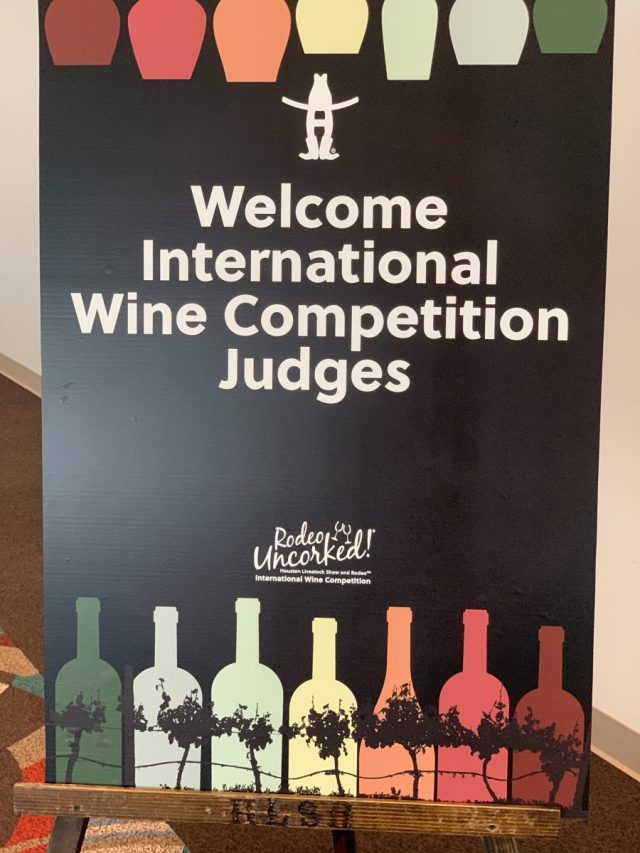
The Rodeo wine competition is more formal.
Last, the second Saturday in December, I will be hosting the Sixth Annual Blind Tasting of American Sparkling Wine. Again, I believe this to be the largest such tasting anywhere in the world as it is solely dedicated to domestic bubbly.
[There is still time to enter that last tasting, by the way, shoot me an email: jeff (at) thedrunkencyclist (dot) com.]
All told, I will likely taste in the neighborhood of 250-300 wines between the three tastings, an ounce and a half at a time, never knowing what is in the glass, always spitting out the wine after a few moments swishing it around between my cheeks.
It is usually that last point that people fixate upon: “Wait, you spit it all out? What if it’s really good?”
One answer is pretty straightforward: if we didn’t spit, we would be hammered in short work (I like to think I could hang on a bit longer, but I digress). The other is a bit more nuanced. I figure that I can actually better ascertain a wine’s merits when I spit it out. Oxygen is key to appreciating the nuances of wine and while some is added upon intake, it is once again aerated by spitting it out (there is always a little that remains).

Imagine how you would be doing if you swallowed a bit of wine from all of these bottles.
Some claim that blind tasting is the best way to assess wine since all there is to go on is what is in the glass. And there is a lot to that since one can not be biased by the label or any connections one might have to the wine or the brand.
That was certainly the case this past weekend as the assembled team of wine writers tasted through 69 American Pinot Noirs. We tasted the wines in flights of four and would discuss the merits (or lack thereof) of each flight before filling our glasses with the next round, not revealing any of the wines until all had been tasted.

One of the wines came off to me as overly sweet (not a good thing) and a bit extracted (again, not good) and I thus rated it accordingly. Once we revealed the identities of all of the wines, this particular wine turned out to be a producer that I respect and usually score the wines quite highly. Had I known what the wine was while tasting it would I have been able to be as objective? I like to think so but the mind doesn’t always cooperate.
Blind tasting also helps to sharpen and hone ones palate since very little is known about the specifics of a given wine. After tasting through 69 Pinots, with two thirds from California and the others from Oregon, one comes away with a sense of what an “American Pinot” tastes like.
Luckily, almost all of the wines we tasted this past weekend were of fairly high quality, with the average retail price right around $45. That is not always the case, however. My first year of judging for the HLSR Wine Competition, one of my categories was “New World Pinot Noir, Under $9” and there were 40 of them.
Yeah, that was rough.

“Flavored Sparkling Wine”





 the drunken cyclist
Pingback: Why I Hate Blind Tastings - Chanting Food