A couple of days ago, I laid out the reasons why the start of November is, in a way, the beginning of my “blind tasting season.” I host two blind tasting events for other writers in the Houston area (American Pinot Noir was last weekend and American Sparkling Wine will be in early December). Add in that I am also a judge for the Houston Livestock Show and Rodeo International Wine Competition, one of the country’s largest blind tastings, and that adds up to tasting about 300 or so wines blind (i.e., not knowing what the wine is when I taste it) over the course of just a few weeks.
But I actually hate blind tastings.
OK, as I tell my boys on a regular basis: “Hate is a strong word and you should avoid it pretty much all the time; there is already too much hate in the world and there is absolutely no reason to add to it.”
Or something like that.
So, I don’t really “hate” blind tastings, but they are not always the “best” way to taste and evaluate wine.
Since I just published a piece about how “Why I Love Blind Tastings” and enumerated the many positives surrounding the practice, I couldn’t really present the counter-arguments with a title such as “Why I Sorta Don’t Like Blind Tastings, Too.” That just sounds wishy-washy and the world has way too much of that, as well.
So why don’t I like blind tastings? To answer that question, it is first necessary to discuss a bit about what blind tastings are.
In brief, at just about every blind tasting, you are given a relatively small amount of wine in a glass and, presumably, you have no idea what it is. When I say “small amount” I really mean it; the “average” pour in a restaurant is probably around 5 ounces (roughly one-fifth of a standard 750 ml bottle). For a blind tasting? You are lucky to even get a third of that. The average size pour at a blind tasting is 1-1.5 ounces.
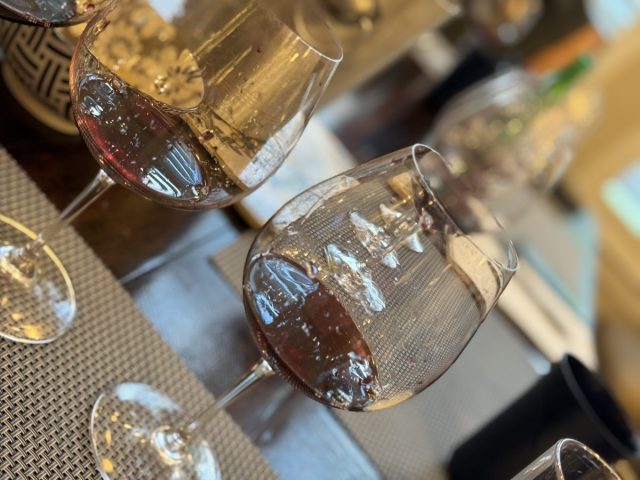
About an ounce and a half.
You then have perhaps a minute or less to taste it, spit it out (a must at all “professional” tastings), perhaps write a few words about the wine, and then evaluate it. And then it is on to the next glass. Sure, you could ask for additional time or a little bit more of any given wine, but both actions will be met with considerable derision from the other tasters on your panel.
So it’s swirl, sniff, swish, spit. Repeat. And don’t take too long on any of those steps.
Succinctly put, that is not how I (or anyone else for that matter) drinks wine. I usually pop a bottle while I am cooking and have a glass, then a bit more with dinner, and then another glass (now hours later) while watching re-runs of Gilligan’s Island.
Don’t judge.
Pun intended.
In other words, for most of the tasting notes that appear here, in this blog, I have tasted each wine at least several different times over the course of several hours (if not days).
Unfortunately, that just can’t happen in a blind tasting.
But.
This past weekend, after tasting through the 69 Pinot Noirs, the other writers involved selected a few bottles that they would like to take home with them. Looking at the nearly six dozen open bottles with nearly 2/3 of the contents remaining, I happily encouraged them to even take more.
I was left with somewhere in the neighborhood of 50 open bottles on my kitchen island, many of which I was eager to try again. In particular, there were two bottles that frankly did not show all that well in the tasting, but I knew from both pedigree and past experience that they should have been stellar.
Thus, after re-corking them tightly on Saturday evening, I tasted them again on Sunday, this time over several hours, watching my Philadelphia Eagles hand the despised Dallas Cowboys a well-deserved loss.
In other words, I tasted these two wines the way I normally would. And boy were they different than during the blind tasting.
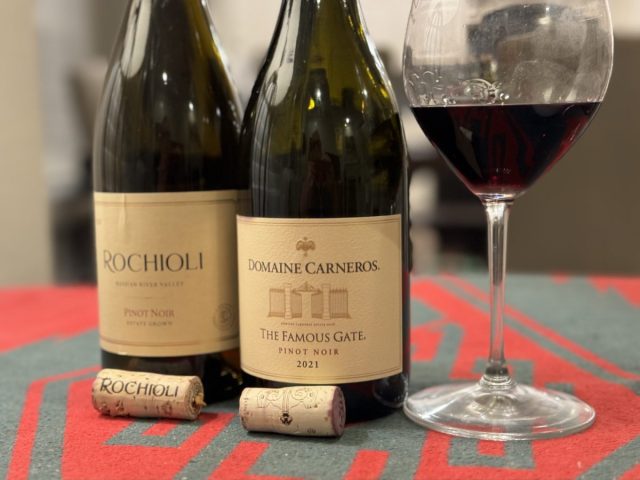
2021 Domaine Carneros Famous Gate Pinot Noir:
My notes from the blind tasting: Dark, on the verge of magenta with a shy nose of red fruit and fairly light in fruit on the palate. Plenty of tartness. A bit hot on the finish. Again, fine, but not much more. Very Good. 88 Points.
The same wine the following day: Retail $95. Heavy Bottle. Under cork. This is a wine that really did not show well during the blind tasting as it was just not very interesting at all. A bit closed, a bit hot, a bit one-dimensional. A day later? The fruit in the glass is dark, even on the verge of brooding with black cherry, blackberry, and maybe even some plum. Add in some dark earth, a bit of black pepper, and some clove; this wine (on day 2) has a ton going on. The palate? Fruity, for sure, but in a more reserved, elegant way, leaving plenty of space for the electric acidity and notable balance. Again, on day 2, this wine gave me what I expected upon opening but is another example that wine does not always “behave” as we would like during a blind tasting. Outstanding. 93 Points.
Rochioli Pinot Noir, Russian River Valley, CA:
My notes from the blind tasting: Medium dark, with darker fruit, even raspberry, earth, spice. Good fruit on the palate, but a tad flabby here until the finish. This might need some time to come together. Very Good. 89 Points.
The same wine the following day: Retail $72. Of the 69 wines in the tasting, few of the wines I received excited me more than this Rochioli. On the day of the tasting, however, this was tighter than a…drum. I was getting very little on the nose and not much more on the palate. But. I could tell. This had the stuffing, it had the goods, but it slept through its alarm. On the following day, however, this beauty woke up and then some. Bright red fruit but also some earth and, curiously, some mocha on the nose. Yowza. Completely alive and vibrant on day two. The palate is rich, layered, fruity, and tart, and in near-perfect harmony. This. This is what I was expecting in the blind tasting, but it was nowhere to be found. On day 2? Oh, baby. This gets a whoa, a wow, and a Holy Cow. Outstanding. 95 Points.
Other wines that were clearly better after having been open for a while as well (the Brooks Crannell and The Sanford Sanford and Benedict come to mind) but that is really the major drawback to a blind tasting; you only get a snapshot of a wine and do not really know how it will evolve over time.
I will continue to conduct my blind tastings, however, as it is a fantastic way to taste a number of wines in a short period of time. It is also a fantastic way to hone one’s tasting skills (yes, tasting wine is a skill that requires practice).
But is blind tasting the “best” way to evaluate a wine? I will leave that for you to judge.
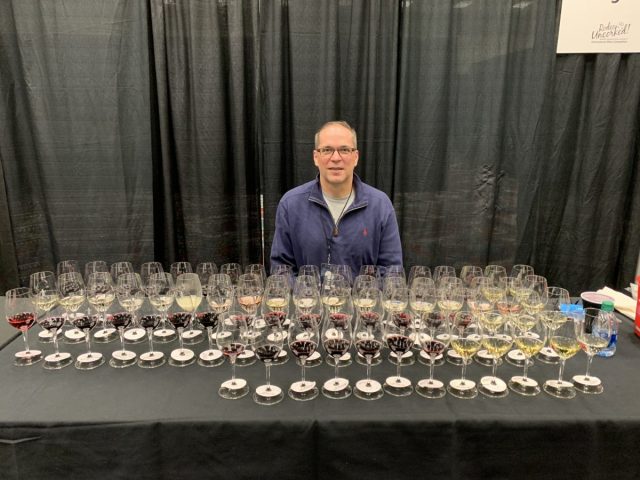
At the HSLR Wine Competition: 66 wines in about an hour, spitting out every one (except the Chardonnay—after the judging was over, I drank the rest of that sucker, it was delicious).





 the drunken cyclist