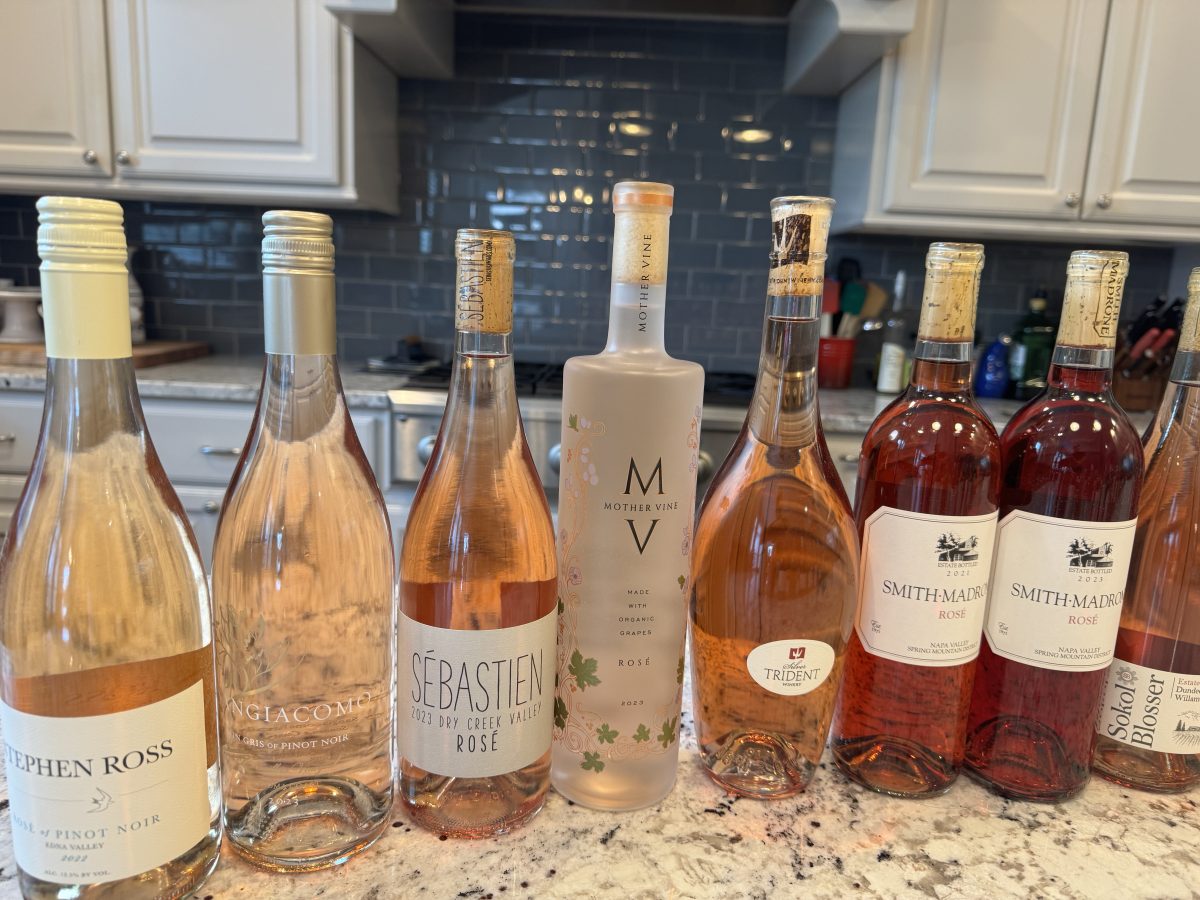
This past Saturday, I invited a few wine professionals here in Houston to my house for what I believe to be the largest blind tasting of American True Rosés, This year we tasted 64 wines, more than last year’s 53 and 2022’s 51, but thankfully slightly lower than 2021’s 68 (four years ago we tasted 74, in 2019 there were 54, 68 in 2018, and the first year we had 36).
What is a “True Rosé”?
Well, there are essentially three ways to make a rosé wine. The first, which is rarely practiced outside of sparkling wine production, is a simple blend of red wine and white wine. The second, which is widely practiced around the world, is called the Saignée Method where shortly after a red grape crush, a portion of the grape juice (after brief contact with the skins) is bled off (“saigné” means “bled” in French). This bled off wine is then vinified as if it were a white wine.
The third option is what I call a “True Rosé.” In this process, the grapes are raised, picked, and processed with the intention of making rosé. True Rosés are therefore not a byproduct of red wine production, they are intentionally or purposefully made. They are True Rosés.
As I have stated before, there are some very good saignées out there. In fact, one of the Top Five wines this year was a saignée. Make no mistake about it, though, a saignée is a by-product of red wine production. Red wines get almost all of their character (i.e., flavors, depth, tannins) from their contact with the skins, seeds, and at times, stems during the maceration period.

All 64.
Early on in that process, about 10-20% of the juice is bled off (saignée) so that the remaining juice has a higher skin-to-juice ratio, thus further concentrating the flavors, depth, and tannins of the red wine. Not long ago (20 years-ish), that bled-off juice was sold as bulk wine or simply dumped down the drain.

The Provençaux take everything about rosé seriously, particularly the color (mandarine, mango, cantaloupe, peach, pomelo, red currant).
A few enterprising winemakers realized that the liquid with a pink hue could be saved, vinified, bottled, and sold as a rosé. Brilliant! (On a side note, today, at least a few winemakers add water back to the reduced juice, thus effectively producing another 20% from the vineyard, but that is for a future post.)
The problem, in my view, is simple: those grapes were grown to be red wine. That means, in general, they were higher in sugar and lower in acidity than would be grapes grown with the purpose of becoming a rosé wine.
Since the vast majority of rosés are vinified like a white wine, which does not derive much (if any) character from the skins, the wines require plenty of fruit and acidity (what many call “freshness”). If the juice comes from grapes that had higher pH (i.e., lower acidity), that key element is lacking. (Another side note: many saignées are made from highly acidic grapes, like Pinot Noir, and thus can make a solid rosé despite the above limitations.)
Saturday, we tried 64 American Rosés on Saturday, trying to find the best. As promised, I am publishing my actual notes from the tasting, which we tasted in 16 flights of four wines. Here is the second set of three flights.
*2021 Smith-Madrone Rosé, Spring Mountain District, Napa Valley, CA: Retail $30. Ridiculously Responsible Bottle (414g; 14.6oz). 67% Cabernet Franc, 33% Merlot. I have been doing this tasting for eight years now and I can safely say that there has not been a bigger difference from one year to the next than with this 2021 Smith-Madrone. Last year, I was not a fan (87 points). This year? Holy cow. Really dark in both color and aromas, this is honestly fairly close to a red. More darker fruit here, plum, raspberry. Good fruit on the palate, even really good with some nice acidity. Whoa. Given the color, I assumed this would be heavy handed, but it really works. Outstanding. 94 Points.

2023 Sangiacomo Wines Vin Gris of Pinot Noir, Sonoma Coast, CA: Retail $36. Responsible Bottle (532g; 1lb 2.8oz). A bit light in the glass with more of classical rosé nose: strawberry, cherry, fantastic. The palate is also quite lovely with vibrant fruit and a brilliant zing. If you don’t like this, you don’t like rosé and we probably can’t be friends. Outstanding. 95 Points.
*2021 Rocky Pond Winery Stratastone Rosé Double D Vineyard, Columbia Valley, WA: Retail $30. Heavy Bottle (636g; 1lb 6.4oz). Grenache, Syrah, Mourvédre, Viognier, Semillon, and Marsanne. More orange than pink with another fantastic nose of red rose petal, strawberry and slightly under-ripe raspberry. Great fruit and plenty of acidity, with a hint of sweetness. Otherwise? This is fantastic. Excellent. 92 Points.
*2022 Purple Star Rosé, Columbia Valley, WA: Retail $20. Ridiculously Responsible Bottle (483g; 17.0oz). 100%(?) Mourvèdre. Another wine with a light, orangish pink color and notes of red berry fruit. A bit lacking in fruit on the palate, but there is a nice tartness and a solid finish. Excellent. 90 Points.
*2022 Pisoni Family Vineyards Lucy Rosé of Pinot Noir, Santa Lucia Highlands, CA: Retail $30. Ridiculously Responsible Bottle (488g; 1lb 1.1oz). Medium to light pink with a dirty nose and some strawberry and rhubarb. Bright and lively on the palate with near impeccable balance. Very nice. Excellent. 92 Points.
*2022 Troon Vineyard Kubli Bench Rosé, Applegate Valley, OR: Retail $25. 55% Mourvèdre, 25% Cinsault, 9% Counoise, 8% Carignan, 3% Négrette. Really, really light in color with a really funky, almost off-putting nose, sulfur, almost barnyard (but not Brett). The palate? Better, with some fruit and tartness, but there is that meaty thing going on here. Very Good. 87 Points.
 *2022 Chehalem Rosé of Pinot Noir, Willamette Valley, OR: Retail $28. Ridiculously Responsible Bottle (460g; 16.2oz). Light color, really light with nice fruit and a touch of minerality and florality. The palate is quite nice with ample fruit and tartness. Excellent. 91 Points.
*2022 Brooks Pinot Noir Rosé, Willamette Valley, OR: Retail $28. Ridiculously Responsible Bottle (435g; 15.3oz). Medium color with a meaty nose with some red fruit. The palate is a bit on the heavy side with that meaty aspect and hints of wild strawberry. Very Good. 89 Points.
2023 Pedroncelli Dry Rosé of Zinfandel, Dry Creek Valley, CA: Retail $22. Medium color, more bubblegum than cotton candy. Intense nose of great ripe strawberry, some sweetness, even close to a Jolly Rancher. Bright and fruity, intense, even on the palate. Bright with tons of body, I am sure this would work well in Texas. Excellent. 92 Points.
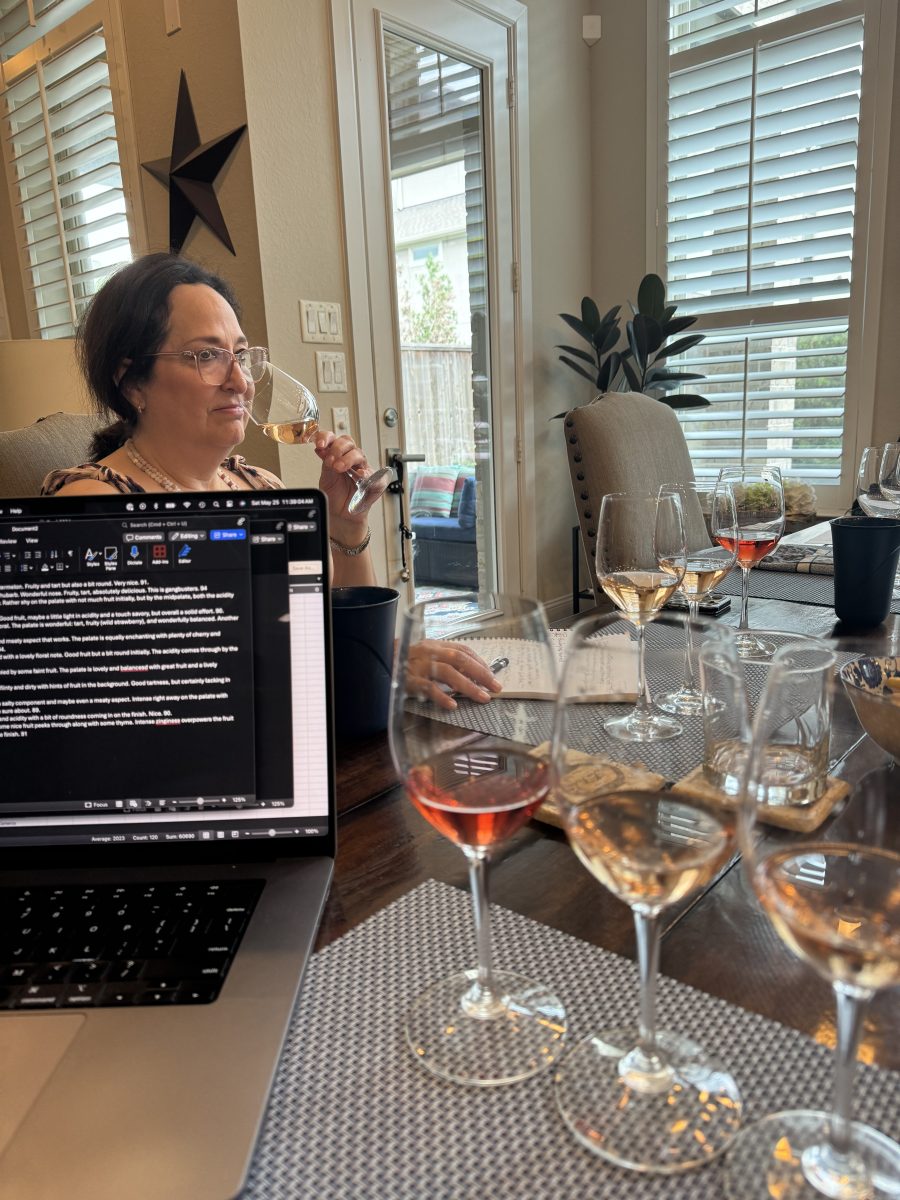
The incomparable Becca Castillo of My Vino Rules.
**2022 Belle Glos Pinot Noir Œil de Perdrix, Sonoma County, CA: Retail $27. Medium to light in color with a bit of salinity, some rhubarb, and underripe cherry on the nose. The palate is meaty, even quite meaty with hints of fruit on the edges. A bit of astringency here, but it works. Excellent. 90 Points.
2023 Youngberg Hill Pinot Noir Rosé, Willamette Valley, OR: Retail $40. On the lighter side in color with good red berry vibe going on the nose. The palate is simply fantastic: great fruit, intense, even, with fantastic acidity. Intense, but lovely. Outstanding. 93 Points.
2023 Clif Family Winery Grenache Rosé, Mendocino, CA: Retail $30. Very light in the glasas with another incredible nose of small red berry fruit, guava, and passion fruit. The palate, again, is fantastically bright, fruity and tart. Outstanding. 96 Points.
Note: Wines with one asterisk (*) were second bottles from last year’s tasting. Wines with two asterisks (**) I actually purchased to include in the tasting.
More coming soon!







 the drunken cyclist
Interesting – did you have many or any Mourvèdre based roses? I saw the Troon – others? These will obviously express themselves quite differently
Cheers
Larry Schaffer Owner / Winemaker for tercero wines 805.245.9584 http://www.tercerowines.com the best is yet to come . . .
LikeLike
Honestly? Not a ton. By far, the majority are Pinot Noir. I did reach out to several non-Pinot rosé producers (e.g., tercero), but I never heard back from any of them. Maybe next year?
LikeLike