
This past weekend, I invited a few wine professionals here in Houston to my house for what I believe to be the largest blind tasting of American True Rosés, This year we tasted 52 wines, which was a bit less than last year’s 64, (two years ago there were 53, three years ago there were 51, four years ago, we had 68, five years ago we tasted 74, in 2019 there were 54, 68 in 2018, and the first year we had 36), while maintaining physical distance (for the most part).
I know what you’re thinking: “Wait, what the heck is a “True Rosé”?
Well, there are essentially three ways to make a rosé wine. The first, which is rarely practiced outside of sparkling wine production, is a simple blend of red wine and white wine. The second, which is widely practiced around the world, is called the Saignée Method where shortly after the fruit intended for red wine is crushed, a portion of the grape juice (after brief contact with the skins) is bled off (“saigné” means “bled” in French). This bled-off pink wine is then vinified as if it were a white wine.
The third option is what I call a “True Rosé.” In this process, the grapes are often planted, raised, picked, and processed with the intention of making rosé. True Rosés are therefore not a byproduct of red wine production (as with a saignée), they are intentionally or purposefully made. They are True Rosés.
This is not to say that all non-True Rosés are “false”–there are many saignées that are wonderful wines. What I am saying, though, is that all other factors being equal, a True Rosé will be “better” than a saignée. Why? Well, simply put there are two main factors that provide structure for a wine: tannins (almost exclusively in red wines) and acidity. Red wines are generally picked at higher sugar and pH (lower acid) levels since the skins contain high levels of tannin. The juice from the red grapes will remain in contact with the skins for an extended amount of time in order to extract those tannins and provide structure for the wines (additional structure, tannins, and flavor can be added by using oak barrels to age the wine).

White wines, on the other hand, usually spend as little time as possible in contact with the skins to avoid the imparting of tannin. Thus, white wines rely almost solely on acidity to provide structure for the wine (oak barrels can also be used with whites but more often than not the barrels used in white wine production are neutral). So, generally speaking, white grapes are picked with lower pH (higher acidity) than their red brethren.
No matter the method, the vast majority of rosés are like white wines as they rely solely on acidity, not tannins, to provide the wine’s structure. So again, all other elements being equal (winemaker, quality of fruit, etc.), a True Rosé is a more desirable way to make a pink wine since it will be higher in acidity and therefore have better structure than a saignée.
Thus, on a beautiful Saturday afternoon, we waded through 52 American True Rosés (OK, there were a few saignées that got in there somehow) four wines at a time, without knowing their identities.

A little less than half of the bottles were from a previous vintage (when wineries send more than one bottle, I save the additional bottles for the following year’s tasting) since it is my contention that well-made rosés do not have to be consumed almost immediately after release. Sure, as with whites and reds, rosés lose a bit of fruit and freshness as they age, but they also develop different flavors as they evolve–just as do all well-made wines regardless of hue.
As promised, I am publishing my actual notes from the tasting of 13 flights of four wines. Here are the first three flights in the order they were tasted.

**2023 Josh Cellars Rosé, California: Retail $16. Heavy Bottle (636g, 1lb 6.4oz). This might be made with Barbera, but I could not verify that. Lovely perfumed nose medium to light color. Fresh strawberry and rose petals. Fruity rich and layered with great acidity. This is a fantastic beginning to the tasting. Excellent. 90 Points.
*2023 Lange Rosé of Pinot Noir, Willamette Valley, OR: Retail $29. 100% Pinot Noir. I really liked this during last year’s tasting (95 Points), but this year was a slightly different story. Light in color with a somewhat muted nose and some “dirty’ red fruit comes through eventually with a salty aspect. Shy on the palate with some fruit coming through on the mid-palate, but the acidity is there throughout. Very Good. 89 Points.
2024 La Crema Pinot Noir Rosé, Monterey, CA: Retail $25. Under screw cap. 100% Pinot Noir. Medium color with strawberry and a hint of rhubarb on the nose. Good fruit on the palate as well, but far from fruit-bomby. Really well balanced and tasty. There is a bit of flintiness on the finish that I didn’t love, but this is a fantastic rosé. Outstanding. 93 Points.
2024 Brooks Pinot Noir Rosé Willamette Valley, Willamette Valley, OR: Retail $32. Under cork. Medium bubblegum color with a lovely nose of bright strawberry and cherry. Good acidity and hints of fruit on the palate with a bit of a spike of acidity on the finish. Excellent. 91 Points.
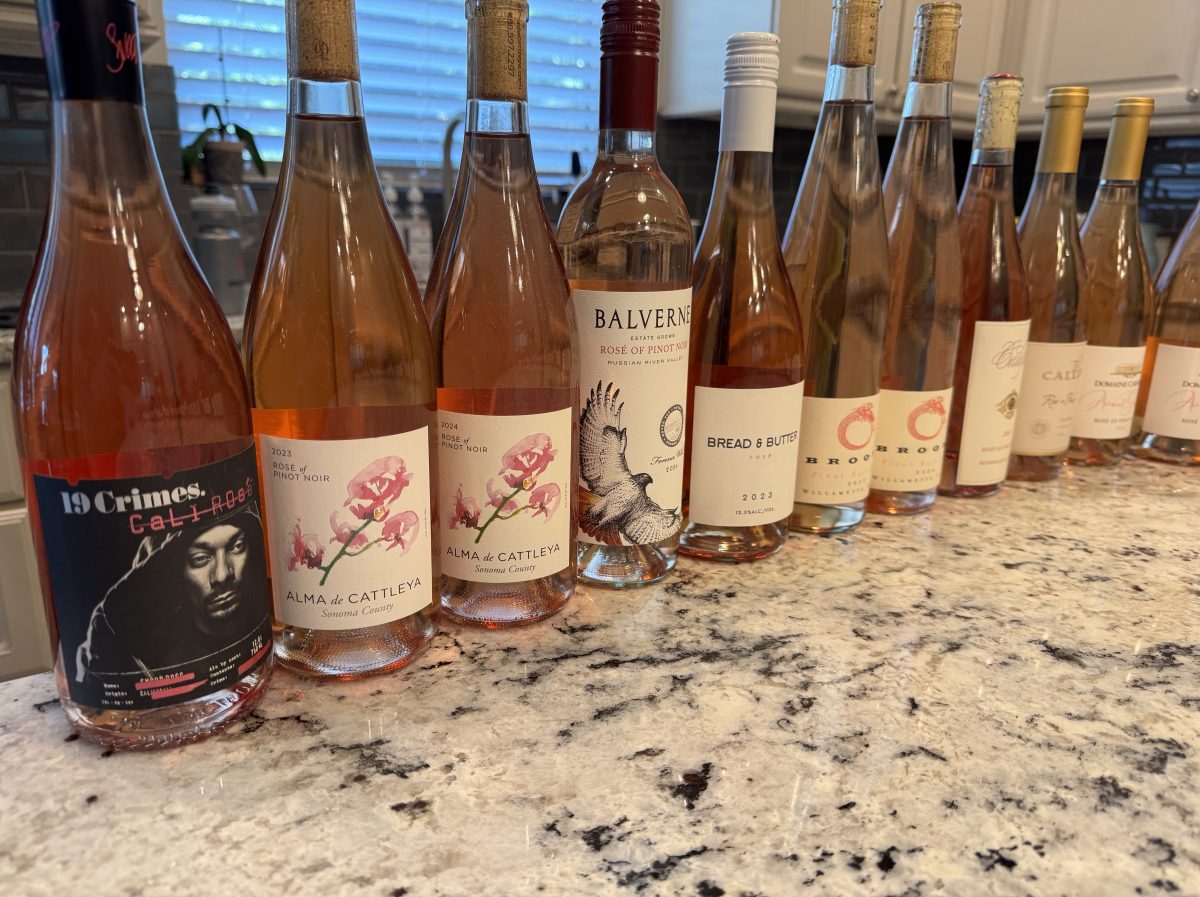
*2023 Chehalem Rosé of Pinot Noir, Willamette Valley, OR: Retail $28. Another wine that I really liked last year (93 Points) but slipped significantly in 2025. Really light in color, practically a white wine. Dirty nose with some tree fruit coming in (mostly pear) and a hint of white peach. Really tart on the palate but not much fruit, honestly. Very Good. 88 Points.
*2023 Rodney Strong Pinot Noir Rosé, Russian River Valley, CA: Retail $25. 100% Pinot Noir. Under screw cap. Another wine that I loved last year (93 Points), but finally one that not only held up but may have improved! Light color with a bubblegum tint to it with a classic rosé nose of red berry fruit and rose petal. Fruity and lush on the palate, with plenty of tartness and a salinity that really works. Outstanding. 94 Points.
2024 Donum Pinot Noir Rosé of Pinot Noir, Carneros, CA: Retail $50. Quite light in the glass, again, closer to a white than a rosé with a very shy nose that eventually reveals a hint of fruit and some minerality. Good acidity on the palate, even really tart, but only subtle hints of fruit. Very Good. 88 Points.
NV 19 Crimes Cali Rosé, California: Retail $15. No idea what grapes are used to make this wine. Rich salmon color with a cotton candy nose; it’s not really fruity at all, more candy-like. Kind of a candied apple vibe? Sweet on the palate, even really sweet, without much acidity to be found. I guess there is a market for this? Would I drink this at a wedding? Or opt for a Bud Light? Tough choice. Good, I guess? 85 Points.

Yours truly, acting like a dork.
2024 Cattleya Alma de Cattleya Rose of Pinot Noir, Sonoma County, CA: Retail $25. Brilliant light bubblegum pink in color, more so than any so far. Fruity and lively in the glass with great cherry and strawberry. Tart, even really tart on the palate with some fruit but it’s somewhat hidden behind all that tartness. Excellent. 90 Points.
**2023 Decoy Rosé, California: Retail $20. 63% Syrah, 16% Carignan, 11% Vermentino, 10% Grenache. More orange than pink with more of a tree fruit vibe of peach and maybe some apricot. Initially a bit sweet on the palate, but it then turns pretty tart on the midpalate. At the end? Decent finish, solid wine. Very Good. 89 Points.
2024 Copain Pinot Noir Rosé, Mendocino, CA: Retail $38. Another really light wine in the glass. Subtle on the nose with some fruit coming through eventually, mostly peach. Lovely, yet subtle on the palate, too, with good balance, but still on the shy side, for sure. Quite Provençal in both appearance and style. Excellent. 91 Points.
2024 The Calling Pinot Noir Fox Den Vineyard, Russian River Valley, CA: Retail $45. Medium color. A vegetal aspect (rhubarb?) along with some peach and maybe a touch of cherry. The palate comes off as a tad sweet due, at least in part, to the rather intense fruit here. This is a big and bold rosé and really stands out in this lineup. Very Good. 89 Points.
Note: Wines with one asterisk (*) were second bottles from last year’s tasting. Wines with two asterisks (**) I actually purchased to include in the tasting.
More coming soon!






 the drunken cyclist