This past weekend, I invited a few wine professionals here in Houston to my house for what I believe to be the largest blind tasting of American True Rosés, This year we tasted 52 wines, which was a bit less than last year’s 64, (two years ago there were 53, three years ago there were 51, four years ago, we had 68, five years ago we tasted 74, in 2019 there were 54, 68 in 2018, and the first year we had 36), while maintaining physical distance (for the most part).
What is a “True Rosé”?
Well, there are essentially three ways to make a rosé wine. The first, which is rarely practiced outside of sparkling wine production, is a simple blend of red wine and white wine. The second, which is widely practiced around the world, is called the Saignée Method where shortly after a red grape crush, a portion of the grape juice (after brief contact with the skins) is bled off (“saigné” means “bled” in French). This bled-off wine is then vinified as if it were a white wine.
The third option is what I call a “True Rosé.” In this process, the grapes are raised, picked, and processed with the intention of making rosé. True Rosés are therefore not a byproduct of red wine production, they are intentionally or purposefully made. They are True Rosés.

Six years ago, just a few days after the Third Annual Largest Blind Tasting of American True Rosés, two articles landed in my inbox. The first was from the online wine publication, Vinepair, and its then Executive Editor Emily Saladino (who has since moved on to be a writer with The Wine Enthusiast) who took a rather meandering look at the current rosé market in the U.S.
Among other puzzling points, Saladino claimed: “At this point, we have absolutely hit peak rosé.” I imagine that she meant that after several years of rather dramatic growth, the U.S. market has become over-saturated with pink wine. She continued, suggesting that the market has nowhere else to go but down since the market is now flooded with hundreds of inexpensive, “bad” rosés.
The other article, by Mitch Frank in the June 30th (2019) issue of Wine Spectator, also took a multi-faceted look at the rosé market (which frankly lacked focus, but that is another matter, perhaps). Among many of his claims, Frank suggested that the current rosé “trend” (which he posited was a step above a”fad”) had likely hit his zenith. He also seemed to imply that rosés, were less serious than other styles of Wine:
And rosé can be a lot of fun, its alluring hues often packaged with eye-catching labels and creative bottle shapes. Market research firm Nielsen claims that 40 percent of rosé consumers are women ages 21 to 34, but the pink wine audience is broader in scope-just search the hashtag “brosé.”
While both articles provided a few interesting points of view and several unsubstantiated assertions, they seemingly based their opinions on the bottom of the market, wines that cost $10 or less. The Spectator article did mention that many of the “new” rosés on the market were saignées, which “was an afterthought, and the quality of most of it reflected that.” Neither of the pieces spent much time on the wines at the upper end of the spectrum, on intentional or True Rosés, which for me represent the best of the category, both in the present and future.
Too many continue to see rosé as a niche, a fad, a non-serious wine that does not require much thought. Well, if our tastings these past nine years are any indication, there are oodles of wines that prove that the rosés at the top of the genre should also be considered outstanding wines regardless of hue.
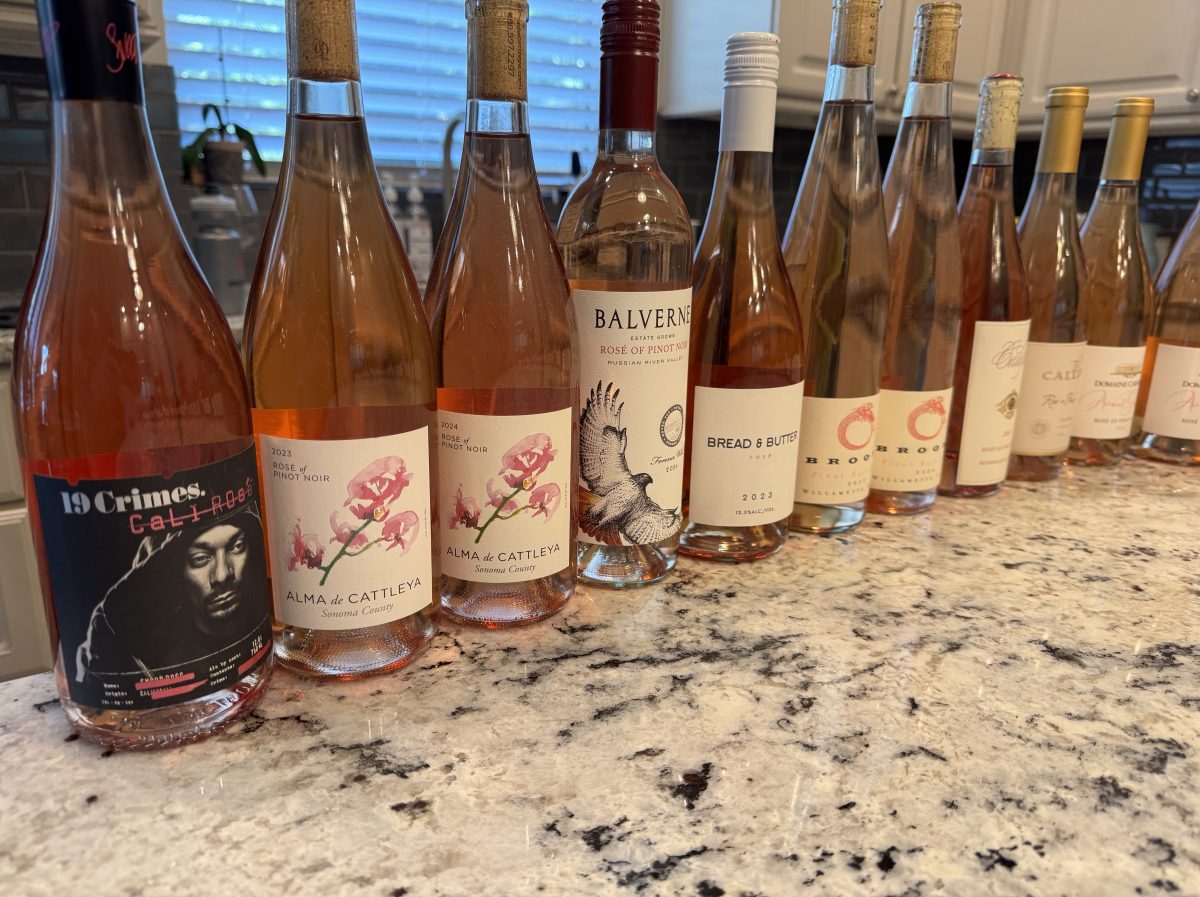
A couple of weeks ago, seven of us tried 52 American Rosés on a glorious Saturday afternoon, trying to find the best. As promised, I am publishing my actual notes from the tasting, which we tasted in 13 flights of 4 wines. Here is the third set of three flights.

2024 The Walls Vineyards Cruel Summer, Walla Walla, WA: Retail $35. 100% Grenache. Quite light in the glass, with more of an orange tint than pink with a completely lovely nose, which comes off as a bit sweet due to the fantastic red berry fruit aromas (strawberry, raspberry). There is also a floral note, a bit hidden behind all that fruit, but this is inviting and fantastic. The palate follows suit, leading with the acidity and ending with more than ample fruit. Fantastic. Outstanding. 94 Points.
*2023 Sokol Blosser Estate Rosé of Pinot Noir, Willamette Valley, OR: Retail $ 28. Medium pinkish-orange in the glass, with a lovely nose of sweet peach and a hint of cherry. Bright and fruity on the palate as well, this really has all that I am looking for in a rosé. Perhaps slightly lacking in acidity, but I am nit-picking. This is fantastic. Outstanding. 93 Points.
2024 Penner-Ash Rosé of Pinot Noir, Willamette Valley, OR: Retail $40. Quite light in the glass (is this a trend?) and quite shy on the nose, as it took considerable coaxing and a bit of warming to get some hints of red fruit. Good, even great fruit on the palate, more of a melon theme (albeit a really tart melon) than red fruit, with nice weight and a bit of a spicy finish. Outstanding. 93 Points.

*2023 Smith-Madrone Rosé, Spring Mountain District, Napa Valley, CA: Retail $30. Very Responsible Bottle (492g; 17.4oz). 50% Merlot, 50% Cabernet Franc. Unfortunately, once I saw this in the glass, I was 90%+ sure that this was the Smith-Madrone. I say “unfortunate” since I really love Smith-Madrone and I loved this wine (as I did last year). But would I have loved it as much as(the other writers were not as taken by the wine) had I not “known”? We will never know. At least not today. Here is my note from the tasting: “Dark, almost a red, pretty sure that this is the Smith-Madrone. Cranberry and intense cherry, with a slight earthy note. Unlike anything thus far, this is big and fruity. Blackberry, raspberry, Bing Cherry, and cassis throughout with great acidity and weight on the palate. Yeah, I dig this wine. Fantastic. Excellent. 92 Points.
2024 Tongue Dancer Pinot Noir Rosé de Ville, Sonoma County, CA: Retail $35. Medium color with an orange tint. The nose comes off as a bit nutty and caramelized with a hint of red berry fruit on the back end. Rich and full-bodied on the palate with those caramel and nutty notes popping up here as well. The fruit is certainly not the driving force here. Very Good. 89 Points.
*2022 Stoller Pinot Noir Rosé, Willamette Valley, OR: Retail $22. Medium orange-ish pink color with a nose laden with peach and with a hint of orange peel. Fruity on the palate with nice weight and acidity, but this is all about the fruit. Excellent. 92 Points.
*2023 Brooks Pinot Noir Rosé, Willamette Valley, OR: Retail $30. Medium pinkish orange with a salty, red fruit, almost caramel nose that is fantastic. This is another wine that is more serious, it’s not just a fruity, tart, glass of wonderfulness, it is more vinous and vibrant. Outstanding. 96 Points.

*2023 Stoller Pinot Noir Rosé, Willamette Valley, OR: Retail $25. Medium color with an enticing nose of sweet, almost caramelized strawberry, the palate is fantastic with subtle fruit and a near-intense acidity. Bigger than most, but big wines need love too. And I am really loving this wine. Excellent. 92 Points.
**2023 Martin Ray Rosé of Pinot Noir, California: Retail $20. Medium to dark orangish salmon color in the glass with decent peach on the nose but the palate is lacking both fruit and acidity. It’s just kinda there. Good. 86 Points.
*2023 Cattleya Alma de Cattleya Rose of Pinot Noir, Sonoma County, CA: Retail $20. Medium to dark in the glass with an intense, rich nose of red berry fruit and a hint of rose petal. The palate is big, and fruity, even really big, but the acidity does a nice job of keeping up. Big, for sure, but I like it. Excellent. 91 Points.

2024 Tongue Dancer Pinot Noir Rosé, Sonoma Coast, CA: Retail $25. Medium pinkish-orange with a sweet nose of peach and melon. Big and fruity on the palate but with really nice acidity. This will challenge your idea of rosé as it does not sit quietly in the corner, but this is really nice. Outstanding. 94 Points.
2022 Tercero Mourvèdre Rosé, Santa Barbara County, CA: Retail $30. In the glass, a lovely medium orange-ish pink, with tons of peach and even some melon; this is inviting. The palate follows along those lines but I feel this has a bit of age on it as there is a slight caramel, nutty component on the finish. This really is quite nice. Excellent. 91 Points.
Note: Wines with one asterisk (*) were second bottles from last year’s tasting. Wines with two asterisks (**) I actually purchased to include in the tasting.
More coming soon!






 the drunken cyclist