Truth be told, I like travelling solo. Don’t get me wrong, I love my family (most of the time) and I value our family vacations, no matter how Griswold-esque they turn out. But when I am alone on the road, it is just a lot easier.
That was clearly evident on our trip to Slovenia last month, particularly concerning meals. Our family is not huge by any definition; there are only four of us, but making a decision about where to eat always seems to be contentious.
That was not the case a month prior, when I was on my own in Italy for a few weeks; every decision I made, whether good or bad, was mine to own, and that seems to work out well. And that was surely the case on my second night in Alba, in the heart of Piedmont.
[Yeesh, reading over those first few paragraphs, it sounds like I really abhor travelling with my family, but I assure you it is not the case; it’s just different.]
From my years of leading bike tours in Europe, I became fairly adept at finding good restaurants, or at least good local spots to eat. What’s the difference? For the most part, I like to eat where the local residents like to eat since the food is usually good to great, the prices are reasonable, and the atmosphere is inviting. All these elements (and a few more, I imagine) are necessary for a local restaurant to survive as compared to a tourist spot, for example, which mainly relies on its location.
My first night in Alba, I did not have much time to do any research and relied on, and I hate admitting this, Yelp to inform my dining choice. And it was fine. It had a good wine list and a solid menu, and the food was good to even great. So what was the problem? It was packed with other Americans who no doubt “discovered” it through…Yelp.
Gulp.
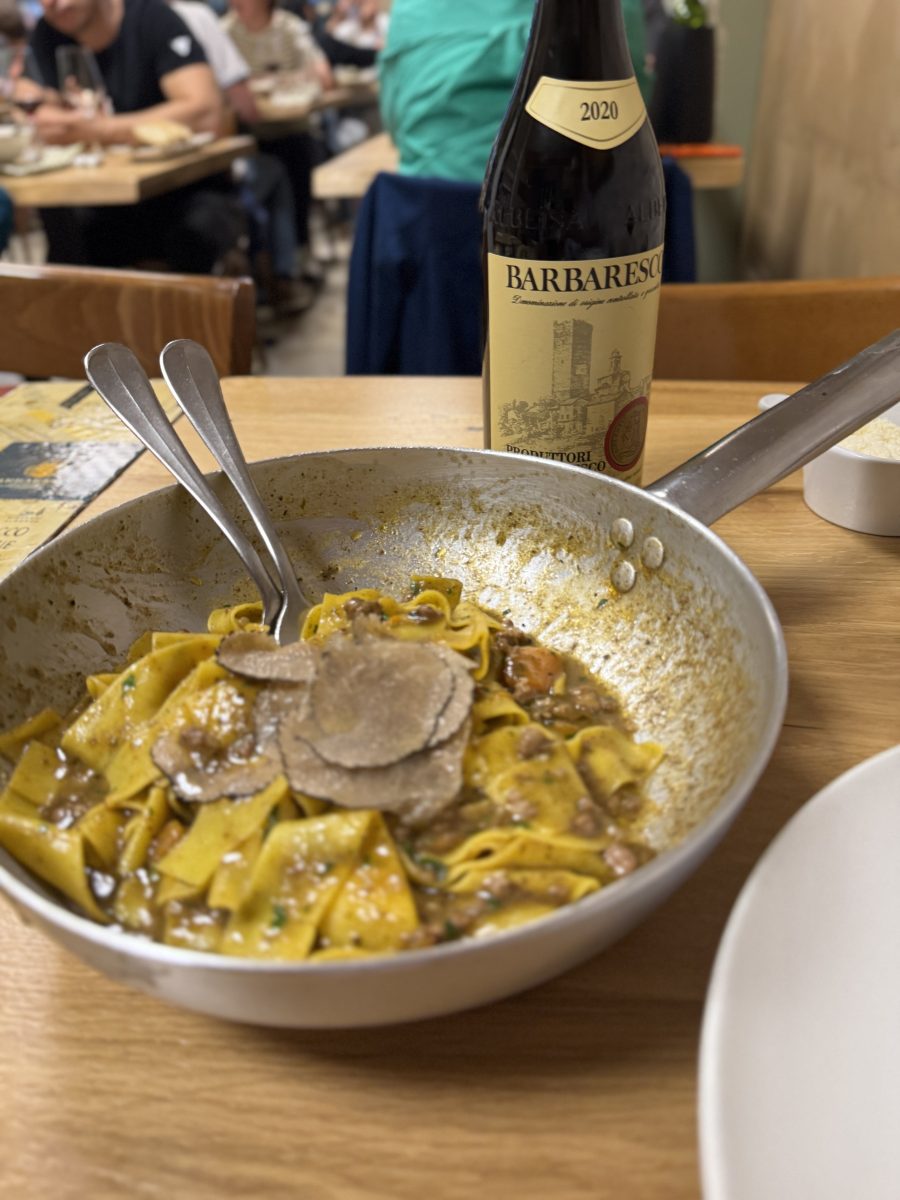
Piedmont in general and Alba in particular are known for their truffles, so I went there on my first night in town, with some fresh pappardelle and a lovely Barbaresco.
2020 Produttori del Barbaresco, Barbaresco, Piedmont, Italy: Restaurant 50€. 100% Nebbiolo. It was my first night in Alba, and I found a nice little restaurant in the center of town with some local specialties and a decent wine list (although said winelist consisted of the various labels of the wines in their cellar; while I understand the concept, it is far too time-consuming to leaf through–yeah, I am that guy). I settled here since I did not want to break the bank on the first night, but I knew this would be a solid choice from a fantastic producer. I was right (I like it when that happens). Fairly dark in the glass with lovely aromas of bright red berry fruit (black cherry, naturally, but I am also getting some ripe strawberry), along with a delightful herbal quality (sweet basil), a touch of earth, and maybe just a hint of anise. The palate is also a delight with oodles of red fruit throughout, a balancing acidity, considerable spice (particularly on the backend), and enough silky tannins on the finish to suggest some further cellaring potential. Fantastic. Outstanding. 93 Points.
The following night, I had a bit more time to plan and I was determined to find a “more authentic” place to dine, and while it was not necessarily “off the beaten path” it was the most memorable meal of the trip, so much so that I went back there again on my last night in Alba (I’m not going to lie, I had pizza on night three; when in Rome…).
I had done some digging online and headed out; it was a short walk from my hotel, but if it were not for Google Maps, I never would have found it. I still might have breezed on by had it not been the near-deafening din of joyful diners chatting away as if they all knew one another (and I think they might have).
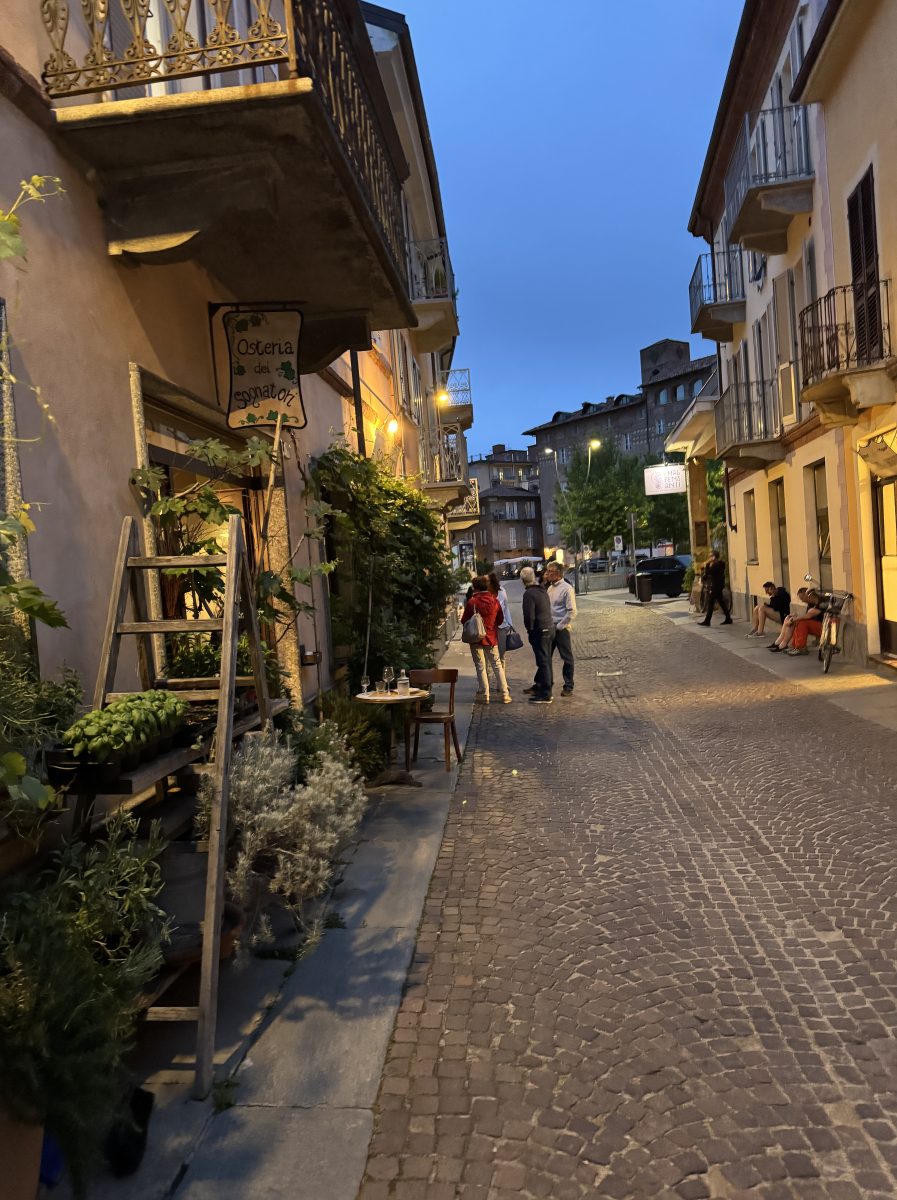
My second dinner in Alba was perhaps the most memorable of the entire trip. I stumbled upon this place, certainly a local hangout (or at least it seemed to me), the Osteria del Sognatori.
The sign on the door was not promising: “Completo” but I had already decided that this was the spot, so I headed in. The owner(?) waved me off, saying that dreaded word “completo”, but I stood there like a dumb American, knowing that he could squeeze me in if he really wanted to; there were several large tables with multiple parties at each.
When he came back around, he said it would be 20 minutes. At least. And instructed me to sit on a bench reminiscent of one that might be found outside a principal’s office. There was only room on the bench for two, but since I had no co-conspirator tonight, I waited alone.
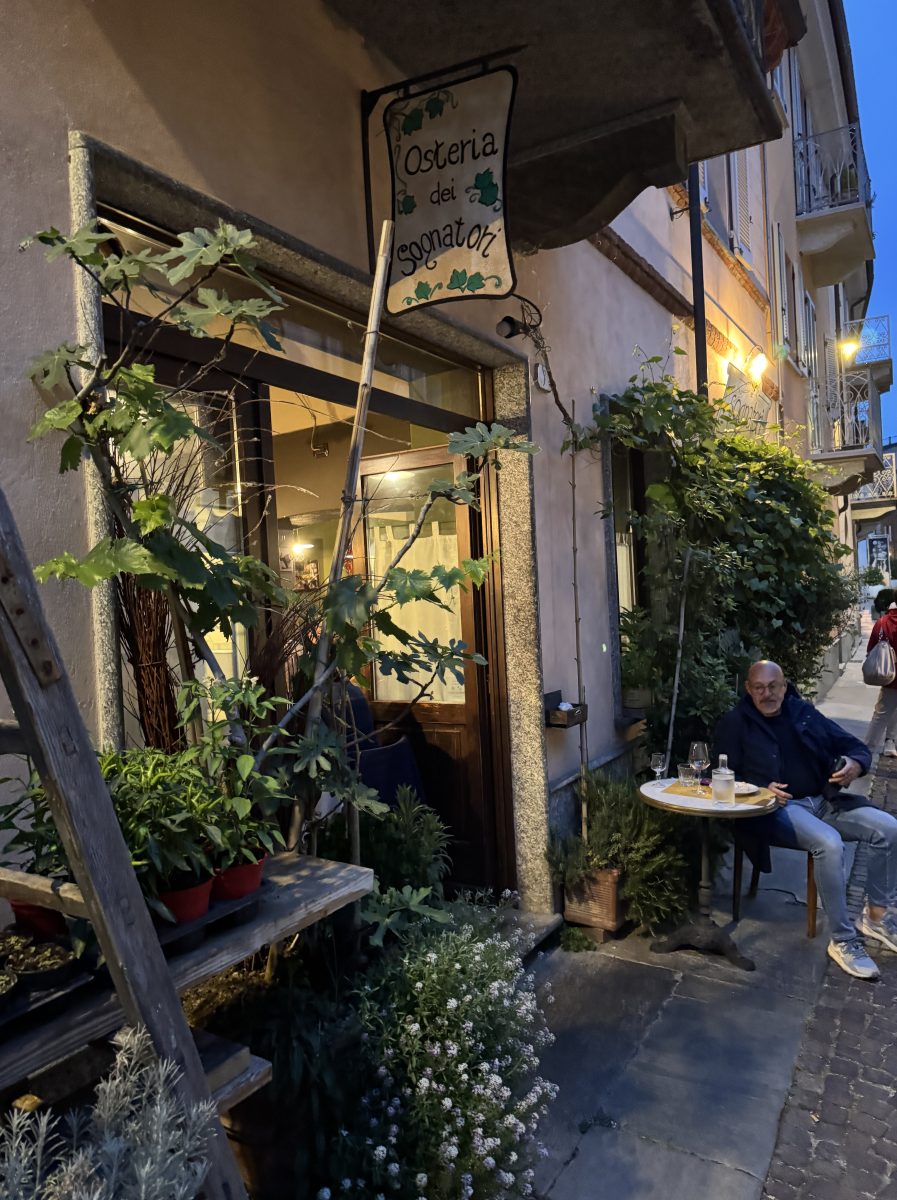
Two very attractive women came in, clearly regulars, clearly with no reservation, and clearly knew how to use their, um, assets to their advantage. I imagined my twenty-minute wait just doubled. At least. When the patron started to clean both sides of the two-top that was literally 18 inches from my knees, I knew my immediate fate was sealed. My goose was cooked. But I had nothing but time, so I was ready to wait.
For about 3.7 seconds, I thought about complaining, but I never want to be “that guy” and particularly in a language that I can only say “tomato”, “cheese”, and “constipated” (you really don’t want to know).
And then he pointed at me.
The table was all mine. The two women seemed to be as shocked as I was as they took over my spot on the “on-deck circle” bench.
It would be impossible to count the amount of time I spent in my years as a tour guide translating menus, particularly when I had little to know familiarity with the local language. What could I have done with all that extra time had I access to “Google Translate” back in the day? Just point your camera at the text and voila!
But the problem at Osteria dei Sognatori? The menu was handwritten. And the person who did the writing had really poor penmanship. Google would be of no help.

Like the wine list (which was a dozen pages long), the night’s menu was handwritten.
From doing my research, two items on the page leapt out at me as they were often cited as local specialties: Vitello Tonnato and Tajarin Ragù. I had a vague understanding that the first was a cold veal dish and the second was the local pasta with a meat sauce, but that was about it. Giddy-up.
The wine list, also handwritten, probably had at least 100 local wines. Sure, there was a page each for Barbaresco and Barolo, but there were at least four pages of the more everyday wines of the region: Barbera d’Alba and d’Asti, Dolceto, Roero, and the less esteemed Langhe Nebbiolo. I asked for his advice, he said, “Nebbiolo, of course”, as if I were some schlub who just got off the proverbial boat (which, in essence, I was). I decided to embrace that perceived ignorance; I asked him to choose for me. He readily agreed, and he even seemed to be slightly excited by the opportunity.
“You want a glass?”, he asked in Italian.
I tried to say “bottle” in Italian. Apparently, he understood.
“Half-bottle?” he said in English, realizing the obvious.
“No, a full bottle”, I said in English, thus completing the capitulation.
I can’t say for certain, but I think this made him even happier.
His English was great and he said straight away: “OK, order a starter, then we will check and see what you want next.” It was a refreshing approach; every other time I had ordered in Italy, they wanted my entire order: antipasti, primi, secondi, and dolci.
[While I am at it, while I love the food, the people, and the country, Italian restaurants are a bit of a scam. Unless you order at least two of the courses, if not all four, you are viewed as a second-class citizen, a red-headed stepchild that just isn’t trying hard enough or is simply too dense to understand. At least it seems that way to me.]
Here is what he selected for me:
2022 Roccheviberti Langhe Nebbiolo, Langhe DOC, Piedmont, Italy: Restaurant 30€. 100% Nebbiolo. Perfect. Initially, fruity and fun, loaded with acidity, which paired wonderfully with my Vitello Tonnato and then my Tajarin Ragù. Yeah, I went full-on local, and this wine delivered. Back in my hotel room, this medium-colored, translucent ruby wine has plenty of blackberry and black cherry as well as rose petal and earth on the nose. The palate is initially dominated by the fruit, so much so that it would be easy to dismiss it as a fun, fruity quaffer. But. It has layer upon layer and has developed more complexity as it opened up. The fruit is always present, but some earth and even some silky tannins come in on the mid-palate, and whoa, the finish. Sure, this is likely on the shelf for around $25(?) in the US, but this drinks like a wine at twice that price. Outstanding. 94 Points.

Vitello Tonnato, a local speciality, is not much on the eyes, but it was certainly delicious.
As the Vitello was served, I scanned the restaurant. It was far from elegant, even very far, but everyone was having the best time, laughing, singing, and even one couple carrying on what seemed like a deep, intense conversation. The two women eventually got their table and melded into the scene seamlessly.

By the time the Tajarin Ragù was served, I felt that I was a part of the celebration. Sure, I had no idea what was being said, but the jovial, convivial atmosphere was so intoxicating that it was impossible to feel left out. Perhaps because of this, that Tajarin was likely the best pasta I have ever tasted.

…. as was the Tamarin ragu, another dish pretty specific to Piedmont.
As I mentioned, I went back to Osteria dei Sognatori two nights later, but my table was outside and across the street, and while the vibe was certainly different, the result was much the same.
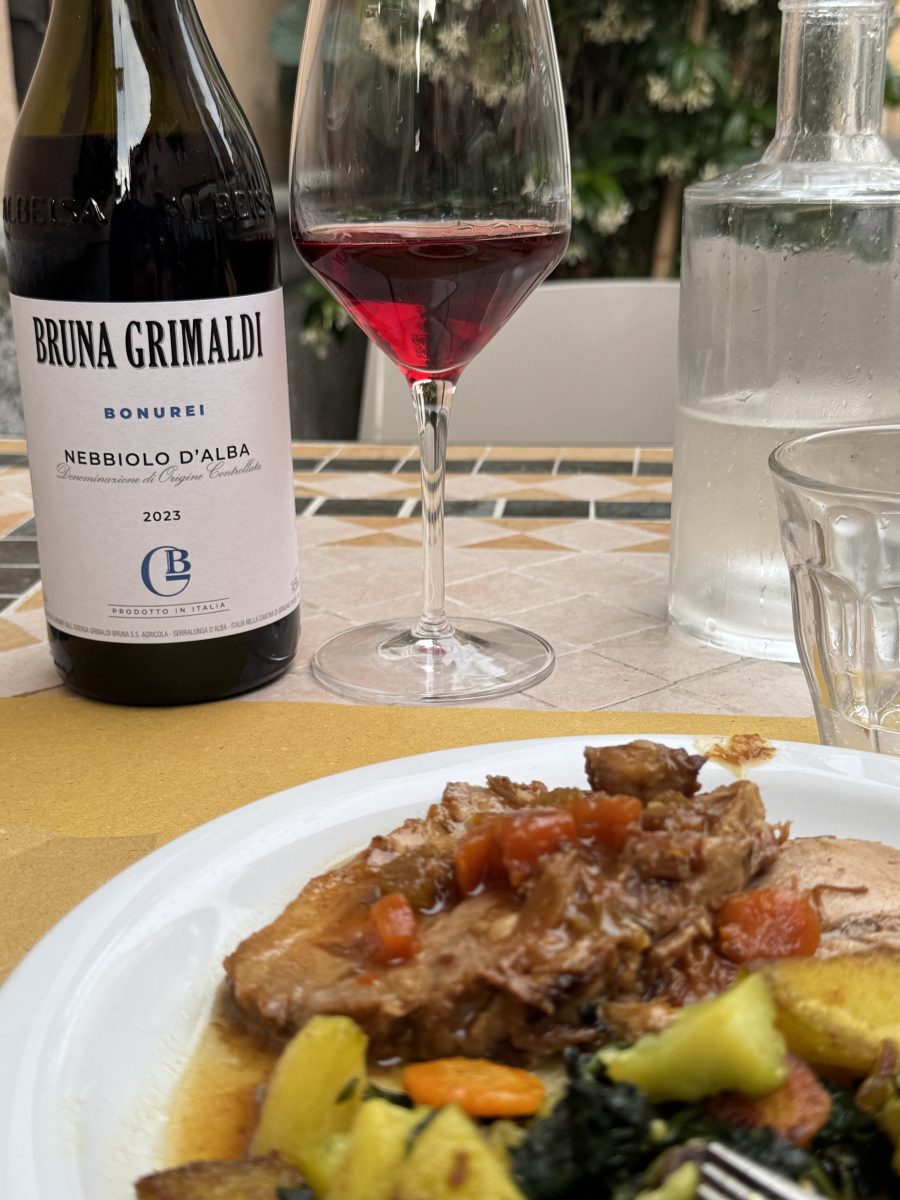 2023 Bruna Grimaldi Bonurei, Nebbiolo d’Alba, Piedmont, Italy: Restaurant 25€. It was my last night in Alba, and I returned to Osteria del Sognatori, where I had been a couple of nights before, and it was amazing. Tonight was equally so, but instead of leaving my wine choice up to the owner, I opted for this wine based on the recommendation of my new friend(?), Marco Riva, winemaker in Roero. Whoa. I always thought of appellations like “Nebbiolo d’Alba” as second-class citizens to the more renowned regions like Barbaresco and Barolo. Well, this beauty will certainly help put that myth to rest. Sure, this might not be able to age like its more esteemed neighbors, but I doubt those B&B wines from the same vintage are drinking as beautifully now. Medium to dark color with rich red fruit, touches of earth, and even a bit of cola thrown in for fun, this wine is incredibly inviting on the nose. And the palate does not disappoint. Fruity, lively, and, yes, rich, this is a complex, delightful red at an everyday(ish) price. Yowza and holy cow. I am so stoked that I will be visiting the winery tomorrow afternoon! Outstanding. 94 Points.
This is why I don’t mind travelling alone, even relish it at times. There are no egos to feed, no questions to ask, and every victory (and failure) is solely mine. And Osteria dei Sognatori was definitely a victory.





 the drunken cyclist
Thanks for sharing your Alba experience with me. Northern Italy and Piemonte is on my shortlist for my next wine vacation. I just got back from ten days in northern Spain, specifically Rioja, Ribera de Duero, San Sebastian and Bilbao. It was festival time so the liveliness with the wine and people made it more enjoyable. Other than the Pinchos, the food was just so-so, and not alot of variety. I was ok with it, because everything else was over top.
If you ever have someone drop out of your wine tasting group, I would love to join you. Best regards,
Mike Salinas, WSET 2 certified and TABC licensed
Find Towntastes on Instagram and FaceBook Business
Email: info@towntastes.com
Tel: (832) 247-4944
http://www.towntastes.com
“Top Marketer of Wine and Food via Demos, Wine Tastings and Events”
LikeLike
Thanks so much for the comment! I have spent some time in San Sebastián and Bilbao, but that is pretty much as far as I have ever ventured into Spain. So you are here in Houston?
LikeLike
I understand traveling and dining, with two kids. Fortunately mine are 39 and 41 and have great palates! It will get easier! Great post.
LikeLiked by 1 person
Ha! Yeah, one of our kids, the older, has a good palate and will eat just about anything. Sebastian, on the other hand…
LikeLike