
Those of you that read this space on at least a regular basis know that I am a bit of a Pinot Noir freak—nearly a third of my cellar is comprised of Pinot Noir and I rarely need an excuse to pull one out. I feel that more than any other variety, Pinot both requires a deft hand and reveals a sense of place. It is also one of the more finicky grapes that will only grow well under the right conditions unlike other more “popular” varieties (cough, cabernet, cough).
My love affair with Pinot Noir started when I shared a couple of bottles of 1962 Beaune 1er Cru and a bottle of1976 Faiveley Chambertin with a few of the clients on one of my bike trips several years ago. The Beaune was earthy and surreal–I had never had a wine that old before. The Faiveley Chambertin (which was only $100 in the restaurant) was ethereal and life altering–it really was poetry in a bottle.
I remained a faithful Burgundy convert for years, eschewing all other versions of Pinot for fear that I would be accused of cheating on the greatest of all still wine regions (let’s not forget that my true love is Champagne). Even after I moved to California, I resisted the local attempts at catching the magic of Pinot in the bottle–I never once visited Sonoma while living just a few miles away (I would visit Napa often, but never Sonoma).
Just before I left the Bay Area for the East Coast, a parent of one of my basketball players, knowing my affinity for Burgundy, gave me a bottle of 1995 Williams Seylem Rochioli (Pinot Noir from the Russian River Valley in California) to try.
It is rather funny to type now, but I was skeptical.
I was getting ready to move to Philly, and just before I left, I decided to pop the cork on the Williams Selyem. It was one of those magical summer days in Sausalito that I miss terribly: warm, even hot during the day, but right around 7:00 in the evening, the fog came rolling over the ridge in waves, instantly dropping the temperature by close to 30 degrees. I grabbed the bottle and a sweatshirt and headed out to the deck.
The wine was phenomenal.
No, it was not a Burgundy, but it showed me another side of Pinot and altered my paradigm permanently. Since then, I have been perpetually searching for great expressions of the variety, anxious to experience its different iterations.
After I started down the Pinot path, I quickly realized that the best (and most expensive) wines are single vineyard designates–the grapes all come from just one vineyard. Sure, there is the blending of wine from different blocks within the same vineyard, but there is little, if any “cross-pollination” of the top level wines.
Just about every Pinot producer will also make a blend or two, which are typically made from lower quality vineyards and/or from the fruit/wine that does not make it in to the producer’s various single vineyard bottlings. They are generally less expensive, but also tend to be less complex.
 A few nights ago, I decided to group a bunch of samples I had received together and had a little “flash wine tasting” out on our front stoop. There are numerous alcoholics on our block, so it was not difficult to find a few others to help me go through the wines (the reviews, however, are my own).
2011 La Crema Pinot Noir Monterey: Retail $23. Black cherry kool aid on the nose. A bit thin on the palate but the black cherry really comes through. Nicely rounded out finish. Good QPR. Very Good 85-87 Points.
2011 La Crema Pinot Noir Sonoma Coast: Retail $25. Much richer nose with some vanilla and even a hint of mocha. On the palate fuller and deeper. Longer finish. Very Good 87-89 Points.
2011 La Crema Pinot Noir Russian River Valley: Retail $40 . Best nose by far with multiple levels of fruit and a hint of earthiness. On the palate a tad disjointed but better acidity and great finish. Very Good to Outstanding 88-90 Points.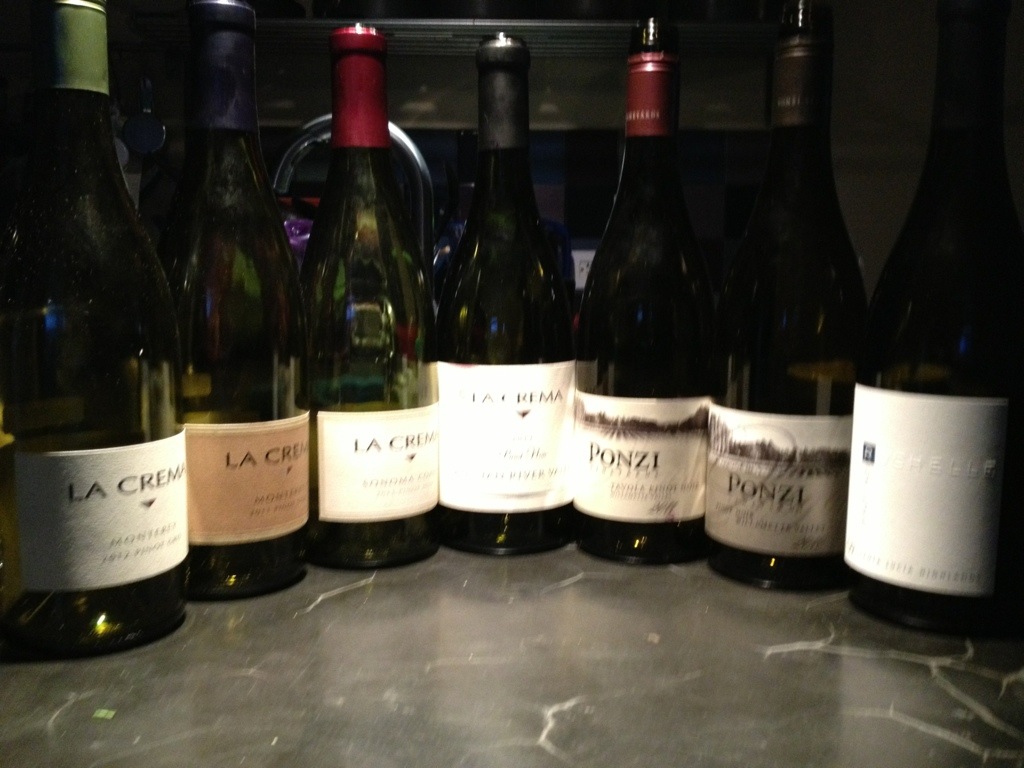
2011 Ponzi Vineyards Pinot Noir Tavola: Retail $25. Nice sour cherry nose and a hint of cinnamon. A bit austere on the palate, but great acidity. Very Good 86-88 Points..
2011 Ponzi Vineyards Pinot Noir Willamette: Retail $35. A bit awkward at first but with air some nice fruit on the nose. Great mouth feel with an earthiness that was lacking in the CA wines. Screaming for a pork chop. Outstanding 89-91 Points.
2009 La Rochelle Pinot Noir Santa Lucia Highlands: Retail $38. Rich raspberry and vanilla. This is my style of CA Pinot. Great fruit and acidity with balance and body. Outstanding 91-93 Points.
2011 Don Sebastiani & Sons Pinot Noir Sonoma Coast: Retail $25. A little hot on the nose. Some red berry and vanilla. On the palate, good fruit and a bit of complexity but a tad short on the finish. Very Good 87-89 Points.
It was a great little flash tasting, but I ended the night with two over-riding questions:
1. Are Pinot blends a better “bargain” or would you rather have two bottles of “Very Good” wine or one bottle of “Outstanding” vineyard designate wines?
2. If some of the best fruit from several of the best vineyards were blended together, would the result be better than the individual wines made from these distinct vineyards?
What do you think?







 the drunken cyclist
La Crema Sonoma Coast is much better than Monterey. I just visited La Crema (all the operations and production) this week. Pretty impressive. Their new winemaker is from New Zelaland. Great guy, lovely crew!
AND – if you ever get the chance, try Fog DOg PN by Freestone / Joseph Phelps. You may end up with a new crush.
AND – Fort Ross Winery makes a mean Pinot Noir. Great one!
LikeLike
I agree—you could really notice a difference between the two Cremas (and the Russian River was better still). Thanks for the pointers on the other wines—I will keep an eye out!
LikeLike
Based on the title alone, you got me confused – I thought you will be talking about actual blends of different grapes and not single vineyard versus not.
I don’t have a good answer for your first question – if one can afford to drink only outstanding wines all the time, why not?
Actually, I don’t have a good answer for the second question either. Depends on the winemaker, on the year, and many other factors. I think if one would blend the wines which are already great, then he/she will do it to achieve something different – not better, but different.
LikeLike
I guess the first question was for those who do have some sort of budget: one bottle at $60 or two at $30?
LikeLike
Again, it depends. Sometimes, one bottle for $60 makes sense. Sometimes, 2 for $30 are better. There is no universal truth.
LikeLike
Aside from the expression of place, I think that blends from different vineyards can be great. In certain years and certain places, one parcel might fill a need that’s going unmet from another parcel. For me, it’s not totally unlike what the Bordelaise do by shuffling their blends albeit in ths case it’s a single varietal. Glad you liked the La Crema Sonoma. Had one the other night and felt it struck the proper balance with some tight finishing – enjoyed with a mushroom and Brie omelet – great!
LikeLike
I was really impressed with those La Crema wines–much more than I thought I would be!
LikeLike
I can’t answer your questions BUT I do wish I lived on your block!
LikeLike
I’ll let you know when there is a house for sale! Seriously, though, we have had a couple flash tastings now and they have been a lot of fun…
LikeLike
A front stoop flash wine tasting . . . brilliant! I think if you truly love Pinot Noir, there’s enough room in your heart for blends AND single vineyard wines . . . Salud!! 😃🍷
LikeLike
I agree that there is room for both! The emphasis is clearly on the single vineyards though.
LikeLike
I guess that I never stopped to ponder those ideas. Since I have enjoyed some of the great Burgundian wines and some Pinot wines that I questioned.if that was actually the grape used. I agree that it is one of the most daunting wines for the grower, so I think that is my major attraction to trying as many as I can, plus I love duck for dinner, and nothing goes as well with that dish as a wonderful Pinot. Notice how I tried to sidestep your question, as I ponder it.
– John
LikeLike
Sidestep all you want! I love the duck as well!
LikeLike
LOL, maybe the next time you visit your old stomping grounds,
LikeLike
I feel like I still am at the point you were at before you opened the Rochioli. The more I learn about my taste buds, the more I realize that I really want earthy aromas in my reds, and all the fruit I can get in my whites…on a mission to make those areas broader….:)
Coming from a total single vineyard culture, with exceptions, naturally, I still am weirded out if I cannot find a vineyard on a label. It’s just so ingrained. I am coming to appreciate the winemaker’s role more and more, so the approach of non single vineyard wines seems to become less important for me…unless it’s my beloved Mosel. Naturally. 🙂
LikeLike
There are certainly some producers out there that hang their hats on blends, but they are often drowned out by the single vineyard craziness. There is still blending going on, but just from one rather specific defined place–a lack of diversity–is that a good thing?
LikeLike
Yeah, I see what you mean. Whatever makes a better final product…but some sites have just SO much to offer that I don’t want it diluted (take my Scharzhofberg, to name just one).
LikeLike
Interesting, I had 4 pinots this week all single vineyard. I think I prefer single vineyard wines they may not be better than some blends but they are distinctive to the paticular vinyard and have more character.
LikeLike
Well, the single vineyard wines almost always take the best fruit/wine and leave the lesser wine for the blends–what if that practice were reversed?
LikeLike
I would agree that the single vineyard Pinots are generally better than the vineyard blends. If I could afford to buy just single vineyard, that would be awesome, but the blends certainly allow this girl to drink Pinot more than I otherwise would! Some of them are pretty spendy! Although the last couple of vintages out of Oregon had a lot of grapes, so the prices seem to be coming down some. Cheers!
LikeLike
There is certainly an advantage for the consumer when there is a bit of a wine glut!
LikeLike
A1) Yes, I think blends from different vineyards are often a better bargin, (if you are looking for bargin Pinot) and maybe a good jumping off point for someone branching out into wine tasting; I perfer a more outstanding Pinot experience and would go for the single vineyard Pinot. My cellar is chocked full of Pinot (Pricey Pinot) – I only purchase bargin Pinot if the crowd I’m serving it to dictates it.
A2) All depends if the grapes slated for blending ‘played well’ together. The great thing about Pinot being grown all around the world is that you get that sence of place – perhaps like very few other grape varities – Pinot runs the gammet from feminine, gem like to a smokey earth masculine type wine. So, even from the same region or vineyard we could get some stylistic difference in the grapes. So I leave the blending and these decisions up to the wine makers whom we trust the juice to. But I am willing and availiable to offer my opinion if offered a taste.
Cheers!
LikeLike
I certainly agree with your first point–I have a bunch of single vineyard bottles and save it for those who will appreciate it. Your second point is also fantastic–the sense of place. I might be splitting hairs, but does a “better” wine supersede a sense of place?
LikeLike
I’d like 2 bottles of outstanding wine, kinda like 2 (oops, make that 3) touchdowns in the first 4 minutes O H
I would think some field blending would make the wine more complex.
LikeLike
-IO!!!! That is my point–more or less: is a phenomenal blend worth more than “sense of place”?
LikeLike
#1 – Wines made from a single vineyard is what we look for. But wines made with blends of different Pinot clones…now there’s some great wines
#2 – Hard to say – depends on the winemaker…
Great article BTW – wish I loved on your block!!!
Cheers
Cindy
LikeLike
I come from a Champagne perspective where it is all about the blend. With Pinot, it is all about the vineyard. Is there potentially a (better) happy medium?
You are welcome to “love” 😉 on our block at any time!
LikeLike
I have had some great single clone Pinots but I really think a blend of them is better…but a lot of times they do t tell you that on the bottle
LikeLike
I think for question number 1 that I would rather have better wine in smaller quantities. Question number 2 is a definitely not, just because the grape is good from all parts doesn’t mean the sum of the parts will be good too. This takes skill to pull this off, and a good blend can still be made from average grape, but a bad blend is always just around the corner
LikeLike
I certainly have followed your response to #1 and I see what you mean about #2–there is no guarantee that the whole is better than the sum of its parts.
LikeLike