This is another in my series about my recent trip to Lodi, California on a media trip sponsored by the Lodi Winegrape Commission with four other bloggers (Amy of Another Wine Blog, Frank of Drink What YOU Like, Gabe of Gabe’s View, and Julia of Wine Julia) and Mark and Claudia from Snooth.com. For most of the trip we were also joined by Jenny Heitman and Camron King of the Wine Grape Commission. In last week’s piece, I gave a bit of the history of the region, particularly the last thirty years as the region seems to be transitioning from a largely bulk wine producing region to one that has more of a focus on quality.
Following our first night in Lodi, the following morning we were up bright and early, off to visit several vineyards, meet a few winemakers, and talk to several of the area’s growers. Personally, I was rather stoked (a California term for “really excited”) since I come from a family of farmers and I often think that in another life I was/will be a toiler of soil, so I figured the growers were my kind of people. (There is no indication, however, that they feel the same toward me….)
At each stop, we heard a bit about the history of the vineyard, learned about some of the challenges faced by the winemakers and growers, and tasted wine made from the fruit that was produced by the century-old gnarled vines that surrounded us (I have never conducted a study, but I can say without much equivocation that tasting a wine in its vineyard is pretty darned badass).
After we all hopped into the van (yes, all nine of us) we started heading east to the Borden Ranch sub-appellation. I did not fully grasp it then, but the Lodi appellation is huge. So big (and diverse) that in 2005, the appellation was subdivided into seven smaller sub-appellations to highlight and delineate the different micro-climates and soil types.

The seven Lodi sub-appellations (click to enlarge).
Our first stop was the Clay Station Vineyard in the Borden Sub-Appellation (which several people referred to as part of the “Toes of the Sierra Foothills”), where we met Robert Pirie, owner of the vineyard management company Colligere Farm Management. It would take some time to list all of Robert’s achievements and activities, but certainly one of his more notable efforts was his involvement creating the Lodi Rules for Sustainable Winegrowing. Enacted in 2005 and revised in 2013, the Lodi Rules is California’s first 3rd party-certified sustainable wine growing program, which promotes “practices that enhance biodiversity, water and air quality, soil health, and employee and community well-being.”

Robert Pirie (right), a vineyard manager and pivotal figure among Lodi wine growers, with Camron King, Executive Director of the Lodi Winegrape Commission, at Clay Station Vineyard in the Borden Ranch Sub-Appellation.
As we drove around the Clay Station Vineyard, which Robert’s company farms for Delicato Family Vineyards (one of the largest producers in the U.S.), Robert mentioned some of the challenges facing winegrowers in general and Lodi in particular. The first is labor, or more precisely, the lack of it, which I will address in a future post. The second was a vine disease, Eutypa, or dead-arm disease, which is a fungus that attacks the trunks and eventually the arms of more mature vines (it seems to occur after the trunk has effectively stopped growing). While some feel that the fruit produced by dead-arm diseased vines is actually more flavorful (d’Arenberg’s oft lauded “Dead Arm” Shiraz comes from Eutypa-infected vines), eventually the vines will die from the infection.
The following day, we visited several century old vineyards, starting with the Noma Vineyard (part of the Mokelumne River Sub-Appellation), on the East side of Lodi, where we met Tim Holdener owner and winemaker at Macchia Wines. Dry farmed by second-generation Lodi farmer (which certainly makes him a “newcomer”) Leland Noma, the 100-year-old vines produce “really intense clusters of fruit” according to Tim. The vines are on their own rootstock since the soil is predominantly sand–the phylloxera louse that has destroyed nearly all vinifera root stocks cannot survive in sandy soil–but the vines only produce a little more than a ton per acre (which is usually not economically viable for Zin). The challenge for the vineyard? It is in an industrial region of Lodi (you can see a bordering warehouse in the photo) and Tim fears that the land might soon become more valuable as industry space and the vineyard will get ripped out. For now? Tim (who started as a home winemaker because the thought of making wine he found romantic–although found it much less so since he started doing it full-time) crafts two wines from the vineyard including a Noma Vineyard Zinfandel for the Lodi Native program (more on that in a couple of weeks).

Tim Holdener (Macchia Wines) giving us a tour of the Noma and Schmeidt vineyards.
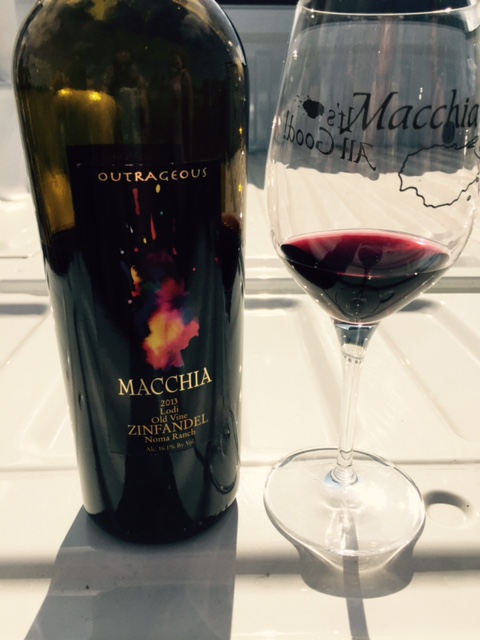
Tim makes a separate vineyard-designate from Noma Vineyard, the “Outrageous” which we tasted among the vines.

In the distance, you can see how industry has crept right up to the edge of these 100 year-old vines.
After Noma, we climbed back aboard the van (yes, all nine of us), and followed Tim over to Schmiedt Vineyard, where I will pick up next week.









The burning question- did you get to ride a tractor?
LikeLike
That comes up in the next part….
LikeLike
And here I thought Lodi was made up for Sons of Anarchy!!! HA!
LikeLike
Ha! You are not the first to think that, I am sure!
LikeLike
Lodi my stomping grounds as the worlds value wine is made there – nice to see them upping their profile with blogger outreach – smart. I see a future in cycling tours of Lodi with insufferable French tourists. Xoxo
LikeLike
They really did a nice job with the trip (although since it was essentially my first trip, I really have no reference). Some of the wine being produced is really fantastic although beyond your preferred price point!
LikeLiked by 1 person