Well, it seems as though I have been able to pull one over on Snooth again. A couple of months ago, they published my first article (on campfire wines) and after submitting some “pitches” to them shortly thereafter, they have published another one of my articles.
There is also a rumor that they are considering a third article, but that remains to be seen–I guess it all depends on whether I can trick them into believing that my writing is actually worthy of their site.
So go over there and check it out and let me know what you think (either here or over there). Click anywhere on the screenshot below to go check it out!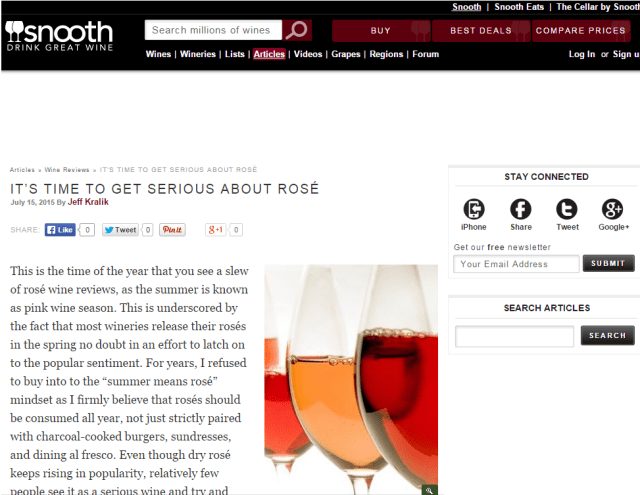









Good for you. Rose, by the way, is my favorite summer wine as they have greatly improved.
LikeLike
Thanks so much! Yes, they have greatly improved, particularly in the US.
LikeLike
Congratulations! Like you, I don’t relegate rosé (or white wines) to the summer, although I do drink more of the latter because of red wine’s not being fond of me 😉 That said, I’m not fond of a sweet rosé and am thrilled at the increasing number of dry rosés available here. What was interesting when I looked at the wines we bought during that wine festival I wrote about a little while ago, is that most of them were “pinks” – rosé, blanc de noir and a “white” merlot. All from local boutique wineries and equally delicious in their own ways.
By the way, one of the questions I asked one of the cellar owners was about the difference between a rosé and a blanc de noir. She said that it was based on colour and not how it’s made. I did enjoy your explanation of the difference between saignée and maceration – another question to ask…in future. Thanks!
LikeLike
What I did not mention in the piece (I was a bit hemmed in by length) was that with just a few exceptions, all juice from wine grapes is clear (Cab, Pinot, Merlot–all clear juice). What makes the wine red (or pink) is the contact with the skins during fermentation. A Blanc de Noirs, technically, is a white wine made from red grapes since the grapes are pressed and immediately taken off the skins so that no color is imparted (this is what happens in Champagne).
LikeLike
Yip, “white” champagne made here from the traditional Pinot Noir is made that way. Of course, we can’t call it Champagne, so it’s labelled “Méthode Cap Classique” or MCC… 🙂 And I’m amazed at how few people know the difference between a sparkling wine that’s had CO2 added. Have a good week!
LikeLiked by 1 person
I have had a few Cap Classiques and have been mightily impressed!
LikeLike
Good article, Jeff. Brief, to the point, and easily understandable. (I did leave a comment on Snooth using my facebook name.)
LikeLike
Thanks so much!
LikeLike
Great article! That is exciting. Cheers!
LikeLike
Thanks for the comment–Cheers!
LikeLike
Very information Jeff, congrats on article #2! Cheering you on for a third one!
LikeLike
The third has been submitted, hopefully soon!
LikeLiked by 1 person
Dude! You’re sabering it – way to go. Number 3! Number 3! Number 3! xoxoxo
LikeLike
Fingers crossed that it will be up soon!
LikeLike
Nice article and reviews! I’m in your camp–I love to drink Rosé year-round too.
LikeLike
Along with sparkling, the most versatile style of wine….
LikeLike
Very exciting – great article!
LikeLike
Thanks so much!
LikeLiked by 1 person