
Over the course of a week, I taste a bunch of wine, usually with friends, and almost always with my wife. Here are some of the wines we tasted this last week that stood out:
2002 Argyle Pinot Noir Spirithouse Reserve Series: Retail $60? Wow. I served this blind and no one guessed Oregon or came close to the vintage. Still plenty of fruit and great complexity. Wow (again). Outstanding. 93-95 Points.
2010 Bonny Doon Vineyard My Favorite Roussanne Beeswax Vineyard: Retail $20? I do not have a bunch of experience with 100% Roussanne, but this was an intriguing wine. Pear and melon on the nose with a bit of herbal tea. On the palate, the rich and unctuous fruit made it seem sweet and the ample acidity held it all together. Not sure that the flavor profile is for everyone (in the same way that Gewurztraminer can be a challenge), but I enjoyed it. Very Good. 87-89 Points.
2006 Campion Pinot Noir: Retail $25. I just finished my stash of the 2005 and this was my first taste of the 2006. Very similar to the previous vintage, I must say, which I enjoyed quite a bit. Not the richest Pinot, but great cherry flavors and enough depth to keep your attention. Very Good. 86-88 Points.
2008 Cosentino Winery The Poet: Retail $45. I probably should not score this wine since I am disappointed and even a little ticked off. Cosentino was largely my gateway wine–Mitch Cosentino hosted the first ever wine dinner I attended and it was the first wine club I joined. There is no doubt that there has been far more Cosentino wine that has passed my lips than any other. Without getting into the reasons why, this wine is a disappointing departure from previous Poets. I would say that the wine is still “Very Good” but it is no where near as complex as previous iterations. Perhaps it needs some time, but there does not seem to be enough tannic structure to support any significant aging. Besides, it has a composite cork–really? A wine that you are selling for $45 and you put that in the neck?
NV Deligeroy Crémant de Loire Rosé Brut: Retail $17. The price has recently gone up on this wine (it was $15), but this remains our “house sparkler” for a good reason: it’s Very Good (and not too expensive). 87-89 Points.
2006 Dutton-Goldfield Pinot Noir Dutton Ranch: Retail $50. There are times in your life when you would love to get a do-over. This wine made me want to go back in time and buy more of it. I got it for a great price and the wine is still rocking. Moral? Ignore my wife when she brings up the “budget.” Outstanding. 91-93 Points.
2002 Fess Parker The Big Easy: Retail $35. Stewed fruit and heat on the nose. Inky dark. Rich and deep with huge fruit, vanilla and oak. Dessert on its own. Whoa. What to pair? That is the question. Very Good. Outstanding? 89-91 Points.
NV Yves Ruffin Champagne Extra Brut Premier Cru: Retail $45? This was available from Last Bottle and I wish I had bought more. Lemon and yeast on the nose. Great acidity and pop with a yeastiness that I really love in champagne. Outstanding. 90-92 Points.
NV Soutiran Champagne Blanc Perle Noir Grand Cru: Retail $50. I have been worried about this as the last couple bottles were a bit tires. This had plenty of bubble and acidity, but also a hint of an old champagne oxidative note, which I really dig. Very Good to Outstanding. 89-91 Points.
2012 Syncline Boushey Vineyard Grenache Blanc: Retail ? Some good friends just recently brought this back from their trip out West. Lemony nose that harkens a Muscadet. On the palate the fruit is a bit muted but is quite tart and bright. Ad it warmed up, more grapefruit and honeydew. Very Good. 87-89 Points.
2002 Travaglini Gattinara: Retail $30. 100% Nebbiolo. While Barolo and Barbaresco get most of the publicity, Gattinara can be a more economical choice to get your fix of Nebbiolo. A bit stewed on the nose but quite earthy on the palate. I do not have a lot of experience with Gattinara, but this was impressive. Maybe a bit old but fantastic. Very Good. 88-90 Points.
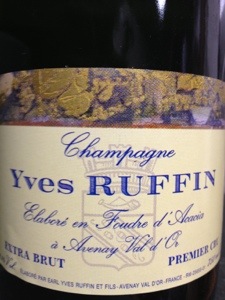 WINE OF THE WEEK: Even by my standards, this was a bit of an odd week chez le Drunken Cyclist. I went through a bunch of samples (at least for me) and my wife was out of town for a few days, but looking back over the week, we still managed to go through a bit of wine (so I guess it was not that odd after all). Normally, I would have thought that the Cosentino Poet would have been the wine of the week. Every time I bring one up, my wife says “Oooh a Poet–what’s the occasion?” It seems that the winery is moving in a different direction though, which is too bad. Either of the two great Pinots, the 2006 Dutton-Goldfield or the 2002 Argyle Spirithouse could (or should) have been chosen in this spot, but instead, I opt for a champagne. We were served the NV Yves Ruffin Champagne Extra Brut Premier Cru by our good friends and it certainly hit the spot–I had spent most of the day baiting hooks, untangling fishing line, and urging the boys not to scream while fishing and a nice glass of champagne was just what I needed. Just goes to show that context does play a major role when tasting/drinking wine.
What was your wine of the week?







 the drunken cyclist
Drank a 2010 trimbach Alsatian Riesling. Always a solid wine, but went really well with what I cooked.
LikeLike
You had me at Alsace!
LikeLike
Drunken C, curious about your comment on the composite cork. Was that coming from the perspective of actual quality or from a marketing perspective? I.e. did it actually bother you to have a composite cork or did it seem cheap and bad for their marketing?
As I was reading it, I was thinking I’d like to have more composite corks. Especially for wines with less tannin structure and age-ability. But as a wine supplier, I agree people definitely see that as a fit for lower priced wines.
LikeLike
Hi Damon, thanks for stopping by and for the comment. I guess I should have explained the comment more thoroughly! First, there is the objective side of using a composite: it is considerably cheaper than “whole” cork; they do not tend to maintain their seal as long as whole cork; and they are still susceptible (although perhaps at a reduced rate) to taint. I would have no problem opening a wine in say the $20 and under price range and finding a composite. By and large, wines in this range are not intended for extended cellaring, so a less expensive closure makes sense. My question would be why not just move to a Stelvin? It has none of the negatives of composite, price differential is negligible, and I feel that twist-offs have shed their former “this is cheap wine” identity. For me, composite says “cheap wine” more than a Stelvin does. I just feel that the composite is a bit of a deception and that the wine maker does not think the consumer will understand the difference (but I stress that is my own personal opinion).
Second, is the subjective side of the episode. Even though I am not much of a ‘Meritage’ connoisseur or expert, I always felt that Cosentino’s Poet was one of the better wines out there (particularly when considering QPR). I would hold onto those wines for years, often waiting 10-15 years before consuming. By putting in a composite cork, the new owners are not so subtly “stating” that they are breaking from the past and that the Poet is now a fruity, intended-for-quick-consumption wine. Well, I wish I had known that before I bought a half a case and convinced several friends to do the same. Cosentino quality has taken a precipitous nose dive since the reorganization and I just think it is a shame. They might be making more money (I have no idea) but they are not making better (or even close to similar) quality wine.
When I pulled out that cork, it served as a symbol of the unfortunate changes at a winery that I used to hold in great esteem.
LikeLike
That’s a great point — makes a lot more sense to me now. I prefer when winemakers move to Stelvin and composite these days on wines they expect to be consumed within 3-5 years. The cost of cork is wasteful.
I do wonder if there is a stratification of consumer expectations based on price. I.e. Consumers who buy $45 wine are more likely to understand the pros and cons of each closure; they like you probably prefer Stelvin for short-term drinkers. Consumers who buy $25 wine might not know the nuances of composite versus cork (nor would they understand the benefits of Stelvin versus cork).
At some point, as you said, it becomes a little bit of a marketing strategic game.
LikeLike
I agree. Boo on the composite. Our WOTW was 2005 Chateau Vieille Cure. Just starting to show some age – dark, black cherries, leather and browning on the rim. Not so heavy as some. Just the way I like ’em. Glad you post these WOTW’s. it gets me to pay better attention to my wines.
LikeLike
Thanks for the comment Duff! I really think there are some great wines to be found in the Bordeaux satellites! We brought back some Bergerac from one of our trips and we love Montbazillac!
LikeLike
The only one of those I have had was the Syncline Grenache Blanc. We visited the tasting room in Feb. 2012 and enjoyed their wines a lot. My wine of the wine was a German Auslese Riesling. I didn’t catch the producer; we drank it while at dinner at my coworker’s brother’s house. I’m sure it was fairly inexpensive, but the laughter made the sweetness of the wine just perfect. I agree, it is often all about context… Cheers!
LikeLike
That should read wine of the WEEK! Geez!
LikeLike
😉
LikeLike
Those Ausleses can get quite pricey! Sounds fantastic, thanks for sharing!
LikeLike
Related to the Cosentino composite cork – The winery went through bankruptcy and was bought. I’m sure the buyers were looking to save money to recoup their investment. From my perspective, they were an outstanding winery that now appears to be just a shell of what they used to be.
LikeLike
Cliff, good insight. Going from cork to composite should save some money.
Straight cork costs about $0.75-1.00 per closure, and composite cork costs about $0.07-0.18, depending on suppliers.
If they are producing 20,000 cases… that could be like $150,000 per vintage!
LikeLike
Cliff, I thought that the bankruptcy would allow them to focus on fewer bottlings and maintain quality. Yeah, I tend to be naive. The wine that they are producing now is no where near the previous quality. Great insight.
LikeLike
While the “base” Gattinara that Travaglini makes is certainly good, try to taste their Riserva if you come across a bottle (particularly the 2007): it is even better.
Regardless, sounds like you had another solid week, wine-wise! 🙂
LikeLike
Will certainly keep my eye out for it (but harbor no illusions that I will find it in PA)!
LikeLike
I can recall a Travaglini Gattinara from the late 90s that was one of my first memorable WOW wines.
LikeLike
This one was really good, but we may have waited a tad too long.
LikeLike