It has been a while since I have had a good rant. I guess I could say that I have not had much to rant about, but that would be far too simple. In the grand scheme of things, I am rather fortunate: two healthy kids, a loving wife (yeah, surprises me too), and a blog that is increasingly popular (if numbers are any indication).
The other day, though, I broke my favorite corkscrew. The worm, the curly part of the corkscrew, snapped as I was trying to extract a cork. I realize that this is what is commonly referred to as a “first world” problem–but it is still a problem, nonetheless.
I have opened thousands of bottles with this corkscrew, so why did it break now? Perhaps it was old and tired (doubtful). The corkscrew could have been of inferior quality and I was on borrowed time (does “Laguiole” mean anything to you?). Maybe it was user error (um, no).
So what was it? Well, the only thing I can come up with is that the cork was not cork at all, but was synthetic–and those “corks” are notorious for being very difficult to remove.
That got me thinking about synthetic stoppers: Why do they exist? What is the theory behind them? Why are they now the scourge of my existence?
First, the positives:
- Synthetic stoppers eliminate the possibility of cork taint. Depending on the source, cork taint (see corked on the Terms page) affects anywhere from 1-10% of wine bottles, and the synthetic stopper virtually eliminates cork taint.
- Synthetic stoppers are cheaper than corks. OK, you want to save a buck, I get it.
- I have heard that they are recyclable. They might be recyclable, but I am really not sure if and how that happens.
- I think I am out of positives.
Now the negatives:
- Synthetic stoppers are not as pliable as cork and can leak. According to Dr. Vinny “Synthetic corks are supposed to expand and seal instantly, but some of the synthetic corks can be firm and not as squishy as natural cork, so they don’t rebound as well after being compressed. I’ve certainly come across some leaky ones in my experience….”
- They just scream “Cheap!” Let’s face it, whenever something “natural” is replaced by something plastic, it is almost always done to save money. I have nothing against saving money, but I do have something against being cheap. Anytime I remove the foil and see a synthetic stopper, I feel as if I had been deceived.
- Environmental impact. Sure, synthetic stoppers are supposedly recyclable, but they have to be produced in the first place, which has far worse impact on the environment than cork trees.
- Restoring the bottle with synthetic stopper is virtually impossible. I guess there are some people out there who do not finish a bottle once open and actually want to save the rest of the wine for a later time (I heard they exist, but I have yet to meet such a person). Well, good luck getting that hunk of plastic back in the bottle.
- A synthetic stopper broke my favorite corkscrew. Clearly this is a negative–I am distraught. OK, that might be a bit over-the-top (but it is close).
Conclusion: Synthetic stoppers are kind of like civil unions–they claim to perform the same purpose as the real thing, but really, they are just a cheap imitation.
The answer?
Screw caps are the answer (gay marriage analogy breaks down here, but that is beside the point).
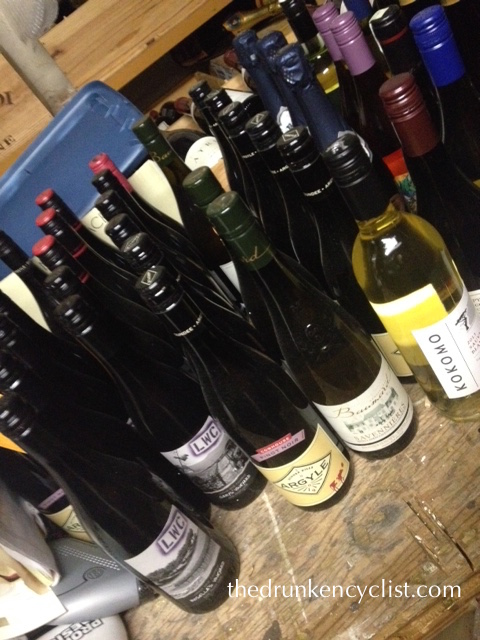
My work bench has been taken over by bottles closed with a screw cap–another bonus: You can store them upright!
There are certainly some arguments against screw caps (aka Stelvin Closures):
- Many people see wines closed with a screw cap as cheap. Certainly in the past, this was the case, but no longer. Many top end producers (Siduri, Loring, Argyle come to mind) have moved to full on Stelvin. Good enough for me.

Even some French producers are putting some wine under the screw!
-

Romantic?
Some argue that there is some sort of “romantic” attachment to opening a bottle of wine with a cork screw. Look, the screw cap is a better closure than a synthetic stopper. Period. I look at it as progress–just because it is new and easier (see #4) it is not “worse”. Is there anything romantic about having to turn the key before starting a car? Or having to actually dial a phone number? Or having to re-fill the ice cube trays? No, no, and no.
- Some claim that screw caps do not allow the micro-oxygenation of wine, thus preventing development. People who claim that there is a difference between cork and a screw top are likely the same ones to claim there is a difference between vinyl and digital music. Sure, there might be a tiny difference, but 99.8% of the population can’t tell (or don’t care). I had a bottle of 2004 Argyle Sprithouse Pinot Noir the other day (that was closed with a screw cap) and although I did not have the same wine closed with cork for comparison, the screw cap closed wine was fabulous.
- Screw caps are exceedingly easy to open and they will not cause you to break your favorite corkscrew!


In the end, I can’t see a single reason to use a synthetic stopper instead of a screw cap, can you?

Synthetic stoppers do make for decent game pieces, though….







 the drunken cyclist
Let’s not forget that synthetic corks are supposed to allow for oxygen transfer like natural corks, but usually don’t…and wind up just leaking.
Given that some award-winning California & New Zealand vineyards have switched to using only screwtops, I don’t knock ’em. (And I actually prefer screwtops for white wine)
But if some synthetic cork destroyed my Laguiole corkscrew, I’d go ballistic. Seriously.
LikeLike
I just don’t get why they exist. Corks are better if you want micro-oxygenation, screw-caps are better if you don’t (or don’t care). Pretty simple to me.
LikeLiked by 1 person
I see your LWC Pinots. I will be enjoying three of those beauties Saturday night. Good wine; closure and all!
LikeLike
I think Brian’s wines are fabulous and do not always get enough credit!
LikeLiked by 1 person
Jeff,
Not all synthetic corks are equal. Those injection molded, plastic plugs that broke your corkscrew (what a shame by the way!) are very characteristic of the negative points you address above about synthetics. Luckily, these plugs continue to dissipate from the market and are being replaced by better, more reliable closures like Nomacorc corks.
Nomacorc engineered corks are 100% recyclable, and we’ve established recycling programs across the country to ensure that our corks (and other types of corks) get recycled. Screw caps are not recyclable. Check out our recent blog post that addresses the recyclability of wine closures: http://www.nomacorc.com/blog/2014/11/recycling-wine-corks/. In addition, Nomacorc introduced this year the world’s first zero carbon wine closure, which is plant-based and derived from sugar cane. Even natural corks have a higher carbon impact than our bio corks: http://www.nomacorc.com/select-bio-series/.
Managing oxygen in wine is an important topic, both for the winemaker and the average consumer. According to the International Wine Challenge, nearly one-third of all noted faults recorded at the competition, were due to reduction, which as you know is often related to tightly-sealed closures like screw caps. Too little or too much oxygen can dramatically impact the flavor and aroma of a wine, and using closures that can precisely control this oxygen ingress is very important for a winemaker. This video helps explain this better: https://www.youtube.com/watch?v=gL_C0mC-ppM.
Breaking your corkscrew is never fun and I definitely understand your frustration. Hopefully next time you will come across a Nomacorc as its flexible skin and interior foam makes it very easy to remove from the bottle.
Cheers and happy sipping,
Whitney Rigsbee, Nomacorc
LikeLike
Whitney, thanks so much for stopping by and for your comments. I know that Nomacorc has been a great sponsor of the Wine Bloggers Conference and I know I really appreciate it.
I have no doubt that Nomacorc is at the forefront in technology and advancements in the synthetic closure industry (I particularly liked Madeline Puckette’s video of her visit to your facility), but I still struggle to see the advantage of a synthetic stopper to a screw cap.
You claim that the screw cap is not recyclable, but in the article you present (thank you for including links), it states that they are recyclable (but it is difficult to do so). There are other articles out there like this one:
http://www.amcor.com/about_us/media_centre/news/191219971.html
that seem to claim that it is not all that difficult to recycle screw caps. So whom to believe? Screw-cap manufacturers or their competitors?
As for the video that you provided (again, thanks for including it in your response), I am afraid that there are those that disagree with your basic premise here as well:
http://wine.appellationamerica.com/wine-review/548/Cork-Breath.html
and
http://wine.appellationamerica.com/wine-review/636/Cork-Breath-Part-2.html
and there are other articles that claim that even the desire to have (what I called) micro-oxygenation is dubious, at best:
http://www.enologyinternational.com/cork/cork.html
As for the corkscrew breaking, while unfortunate, it merely served as a catalyst to finally put in to writing feelings that I have possessed for quite some time.
Thank you again for your well thought-out arguments and hopefully we can continue this “debate” for I feel there is certainly no “right” answer (at least convincingly so).
LikeLike
Hi Jeff,
Thanks for your feedback. We love supporting the Wine Bloggers Conference every year!
You are correct. I meant to indicate that screw caps are recyclable but due to its small size and mixed materials, it can be difficult to recycle. In fact, all types of closures are often not accepted in public recycling streams due to their small size. For that reason, Nomacorc has established recycling programs with many retailers to ensure that our wine closures are properly recycled: http://www.nomacorc.com/wine-closure-recycling-programs/
Thanks for providing the links regarding oxygen management and wine closures. There are many opinions and studies out there regarding this issue, but I’d like to provide you with some links that are more current than the ones you quoted above and that have been reviewed and accredited by scientific journals. Here’s one study published in the Journal of Agricultural and Food Chemistry http://pubs.acs.org/doi/abs/10.1021/jf400810v which addresses wine aroma evolution and the influence of oxygen. Another study published by the natural cork industry also confirms a cork’s ability to breathe. http://ajevonline.org/content/64/3/395.abstract?sid=c487cd8a-b968-4214-b969-c266085d3281.
Lastly, I think you might enjoy reading a study that was recently published in the December issue of Wines & Vines magazine that addresses bottle-to-bottle inconsistency with screw caps, particularly at bottling. Here you will see that the sampled screw capped wines had the highest Headspace Oxygen (HSO) and variability which is often due to the difficulty to create a consistent seal when applying the caps during bottling: http://www.winesandvines.com/digitaledition/.
Thanks again for your comments and feedback. If you have any other questions, please do not hesitate to reach out.
Cheers,
Whitney Rigsbee
Nomacorc
LikeLike
Thanks again Whitney for your thoughtful response. I tried to read the papers you linked, but only the abstracts are available. Any chance you could send me a pdf? I would love to read them. jeff (at) thedrunkencyclist (dot) com
LikeLike
I don’t mind screwtops for sheer convenience, but I am a romantic for the process of uncorking. Of course it wouldn’t surprise you that I’m listening to Vinyl right now. Maybe more surprising – hank Williams Sr.
Bummer about the corkscrew. I love my Laguiole.
LikeLiked by 1 person
I always took you for a hopeless romantic….
LikeLike
Give me cork or Stelvin, or give me death! 😉
LikeLike
😎
LikeLike
I love real corks — and not just for the seven billion crafts you can make with them. There’s just something about cork that’s cool and almost nostalgic. But, I’m not a fan of synthetic corks. Every time I peel back the foil on a bottle of wine and see one staring up at me . . . Sigh. That said, I made my peace with screw-caps a long time ago, and Loring Wine played a big role in that detente. Salud!
LikeLike
I just feel that they are hiding something using a synthetic cork. The type of closure used should be able to be determined before purchasing the bottle, in my opinion….
LikeLike
I did not see this coming… you’re endorsing screw tops??? Or are you just in favor of anything that isn’t a faux cork? 🙂
LikeLike
I LOVE the screw cap! Easy, efficient, can store the bottles upright. Win, win, win.
LikeLiked by 1 person
After a long day, I love screw tops for their ease of use, but I too am a romantic when it comes to corks. I like the ritual of removing it. Still I’ve had plenty of natural corks break on me and drop little bits into the bottle. I’ve never had a problem with a synthetic cork.
LikeLike
Yeah, the synthetics don’t themselves break, but I have never heard any one say that they would keep a wine under synthetic long enough to see what happens (in my experience, well over 90% of the corks that break are in bottles that are 5-10+ old–would you keep a synthetic stopper wine that long–that is if you knew the bottle were closed that way….).
LikeLike
That I don’t know. I would hope they don’t use synthetic stoppers for wines that are to be laid down, if the synthetics don’t match the life of the bottle. But has anyone tried a screw top for a long-lived wine?
LikeLike
I know that there have been some tests, but you really can’t trust many of the results since most have an agenda. I do know I had an ’04 Pinot recently that was very good….
LikeLike
Both have benefits 🙂 )
LikeLike
Not sure of the benefit of the synthetic cork over the screw cap (other than the “romantic” angle, which I don’t buy at all).
LikeLike
Seriously Dude? You have to know that the corkscrew thing was the corks revenge for you sabering those bottles and posting it online! LOL 🙂
LikeLike
Ha! Comment of the year?
LikeLike
Sorry everyone. I didn’t realize how that sounded. Please accept my apology.
LikeLike
Growing up in New Zealand and spending time in Australia I barely notice a screw cap. Now living in Hong Kong with greater access to a wider range of wines and drinking more wine under cork than ever – and having a fair few bottles spoilt by cork taint – give me a well made wine under screw cap any time. I’m more concerned with what’s in my glass that how it was opened. Except when it comes to Champagne of course!! 🙂
LikeLike
“I’m more concerned with what’s in my glass that how it was opened”
Exactly!!!
LikeLiked by 1 person
No, I thought it was brilliant!
LikeLike
Thanks! Happy Thanksgiving to you and your family. You have done a great job developing your blog and all your social media. It seems like yesterday that I started my blog and found you just starting yours. I am happy to have shared this journey with you and look forward to what is ahead. Cheers my friend!
LikeLiked by 1 person
Thanks to you as well! It has been a lot of fun–we have come rather far since those “early” days, no?
LikeLiked by 1 person
But if the world only consisted of screw caps you’d never have had a favourite cork-screw
LikeLike
Touché! I guess if the quick release was never invented, we would all look at changing flats differently as well!
LikeLike
A sad story about your corkscrew. And a good perspective as well 🙂 I love old corks, but I have had two expensive bottles of wine go bad due to cork rot ~ so a part of me is very happy to see the synthetic ones…
LikeLike
But would you let two “expensive bottles” age for that long under synthetic? First, the wine producers would never put it under synthetic, but if they did, I would be ticked off!
LikeLike
Hmmm, I probably would because I also once kept an expensive bottle of wine in my HK apartment (in the open room) during the summer…sometimes logic and I have our battles 🙂
LikeLiked by 1 person
While I have never been to HK, I assume that it gets quite hot there in the summer…. Yeah, that’s not good for wine….
LikeLike
Very much agree with you, Jeff. Synthetic corks are bad and I try not to buy wines that use them. If a winery does not want to use natural cork then they should use glass stoppers in my opinion. Glass stoppers work just fine but have a higher production cost than natural cork.
Cheers!
LikeLike
Glass stoppers are a nice option!
LikeLike
LOVE! I am so sorry about your corkscrew — I hope you got an industrial strength one to last!
LikeLike
I have a few spares!
LikeLike
Great piece. I like every alternative enclosure that prevents TCA, and have not experienced the negatives. I’m a fan of the Brookstone corkscrew and its replaceable worm, but I also have a wonderful waiter’s corkscrew with a foil remover that will eventually break. Cheers!
LikeLike
I will have to look into those replaceable worm corkscrews!
LikeLike