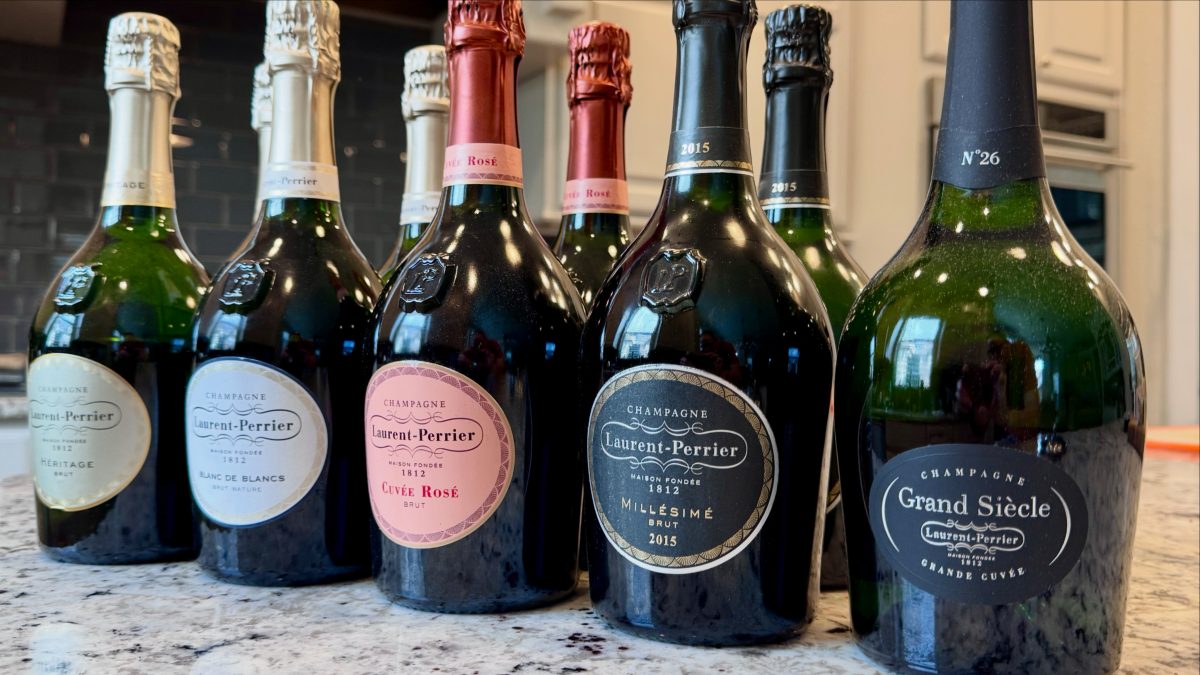
As I mentioned a couple of weeks ago, I was recently approached by Laurent-Perrier Champagne to see if I would like to sample several of their iconic wines, to which I quickly responded “oui!” (I actually said “yes” as the conversation was conducted in English, but I wish I had responded in French). First, I tasted the flagship La Cuvée, as a bit of an introduction, a few weeks ago, I provided a brief history of the iconic house while sipping on the 2015 Millésimé. Next, I discussed one of the three pillars of the Laurent-Perrier house, what they call their “Savoir-Faire”, the Art of the Blend, or Assemblage. And most recently, I explored the second Savoir-Faire–the Art of Maceration.
This week, I shift to the third of the three Savoir-Faire of Laurent-Perrier, Le Non Dosé
Champagne has not always been the “luxury” that it is today nor was it always a sparkling wine. In fact, for the better part of a few centuries, the bubbles were seen as a fault, not the desired outcome. Not too long after harvest, winemakers, thinking the fermentation process was complete, would bottle their still wine, believing their job was done. The problem was the fermentation was not complete, the yeast had gone dormant due to the chilly temperatures typical in Champagne. When the temperature rose the following spring, the yeast would surge back to life, consuming the remaining sugar in the wine, creating more alcohol and carbon dioxide, which would be trapped in the bottle in the form of…bubbles.
Venturing into a cellar room in Champagne in the 17th and 18th centuries could be a dangerous endeavor; bottle explosions were commonplace as some producers could lose up to half their production (not to mention a few employees) to sudden bottle blowouts. The introduction of stronger glass and a better understanding of the fermentation process helped reduce catastrophic failures, but winemakers were faced with another problem. The finished wine was extremely acidic, as the northern region struggled to get fruit ripe.
Dosage, the addition of sugar to champagne right after disgorgement (the removal of the dead yeast cells) and right before corking, was introduced in Champagne early in the 19th Century to render the wines more palatable as the additional sugar served to soften the harsh acidity. This also made champagne more desirable in foreign markets, particularly to the east, where Germany had a history of sweet wine consumption, and the Russian aristocracy liked their wines extremely sweet.
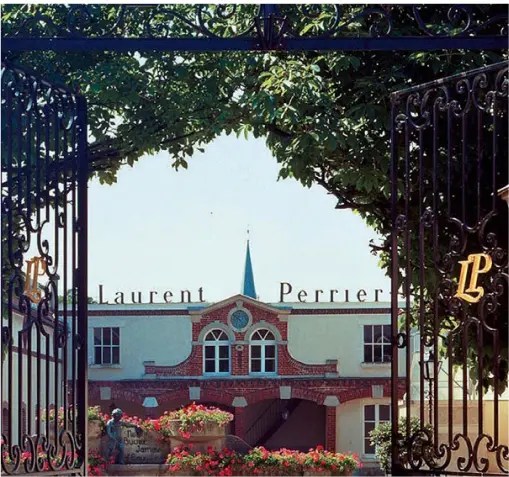
Many of those early sparkling champagnes had incredibly high levels of sugar, as much as 200-300 grams per liter (the sweetest champagnes today are, by contrast, around 50 g/l, and the standard Brut is usually no more than 10 g/l), and champagne was seen as mostly a desert beverage. By the end of the 19th Century, however, tastes had begun to change, particularly in Britain, where drier styles were coveted. This prompted Laurent-Perrier to develop its “Grand Vin Sans Sucre”, one of the first Non-Dosage wines in Champagne, which was introduced in 1889.
Over the course of the next century, zero-dosage wines had virtually disappeared, given the challenges of the Champagne region–the fruit simply did not get consistently ripe enough and the resulting wines were bracingly tart without the introduction of at least some sugar.
Not too long after taking over Laurent-Perrier mid-20th Century, Bernard de Nonancourt realized that the key to producing a quality non-dosage wine was much more complex than simply “not adding sugar”. He realized that the addition of sugar not only helped to mitigate acidity, but it also served to mask other issues in the wine. In order to make a non-dosage wine that would live up to the standards he was creating at Laurent-Perrier, farming practices would need to improve to maximize ripeness and fruit selection, for maturity and complexity, would need to be prioritized.
In 1981, Laurent-Perrier introduced the first Ultra Brut, a non-dosage wine that preceded the current obsession with low or non-dosage wines by several decades. In fact, it helped to establish two new categories of champagne: Extra-Brut (3-6 g/l of residual sugar) and Brut Nature (less than 3 g/l) became official in 1985 and 1996, respectively.
Then, in 2019, Laurent-Perrier was once again at the forefront of innovation, introducing its first Blanc de Blancs Brut Nature, one of the few 100% Chardonnay, non-dosage wines available. It is a blend of fruit meticulously selected from the best regions for Chardonnay from the Montagne de Reims and the Côte des Blancs in Champagne, blended with reserve wines for added depth and complexity and aged for eight years before release (champagne is only legally required to be aged 15 months, and most non-vintage wines are aged for about three years).
I had the pleasure to taste this incredible wine a couple of weeks ago, at my home in Houston.
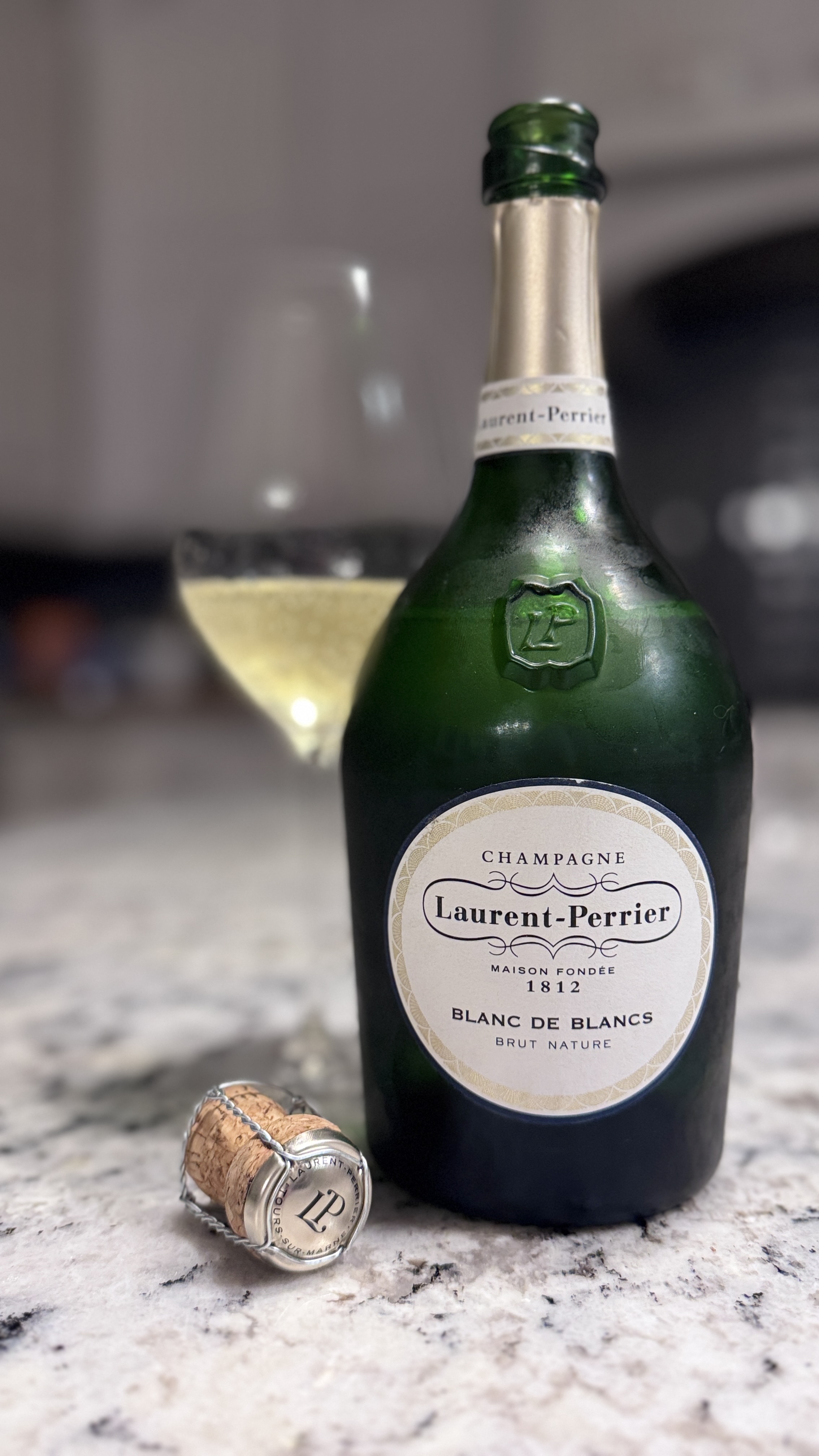
NV Laurent-Perrier Champagne Blanc de Blancs Brut Nature, Champagne, France: Retail $105. Extremely Heavy Bottle (899g; 31.6oz). 100% Chardonnay 100 % from Avize, Cramant, Oiry, Chouilly (Côte des Blancs) and Tours-sur-Marne, Villers-Marmery, Rilly La Montagne (la Montagne de Reims). This is now the fifth different cuvée that I have tried from Laurent-Perrier, and more than any other, this Blanc de Blancs Brut Nature has caused introspection. Don’t get me wrong: the other champagnes from the house were incredible in their own right, but this Brut Nature is another animal altogether. Whoa. First, this needs to be served at near cellar (or even room) temperature as the cold tends to mute many of the aromas and flavors both on the nose and the palate. Second, whoa (but I already said that?). Third, this wine requires, even demands introspection. Sure, one could toss this back as a classic apéritif with a half-dozen oysters and be content to let the evening unfold. But. Whoa. Fairly pale straw in the glass with a bevvy of tree fruit on the nose: peach, pear, hints of apple, dominate. But there is also considerable minerality and a significant floral quality that one would expect from a BdB. Then there is the toasty, yeasty aspect (eight years on the lees) which not only entices but seduces, luring one into further exploration. The palate? Whoa. It is certainly tart, even on the verge of overly so, but with some patience, it is clear that this is a magnificent wine. Layered and complex with subtle power and oodles of finesse, this wine, in and of itself, is worthy of an evening on its own, without any food as accompaniment. But, of course, it is alongside myriad dishes that this wine would meet its apogee; the aforementioned oysters, seafood risotto, gruyère mac and cheese, even Cape Cod potato chips and an episode of John Oliver; the list is near endless. A complete delight and, frankly, a wine that will continue to evolve (and improve) for a decade or more, easily. Outstanding. 96 Points.