As I mentioned a couple of weeks ago, I was recently approached by Laurent-Perrier Champagne to see if I would like to sample several of their iconic wines, to which I quickly responded “oui!” (I actually said “yes” as the conversation was conducted in English, but I wish I had responded in French). A couple weeks ago, I tasted the flagship La Cuvée as a bit of an introduction, a couple of weeks ago, I provided a brief history of the iconic house while sipping on the 2015 Millésimé. Most recently, I discussed one of the three pillars of the Laurent-Perrier house, what they call their “Savoir-Faire”, the Art of the Blend, or Assemblage.
This week, I shift to the second of the three Savoir-Faire of Laurent-Perrier, La Macération
For the past ten years or so, I have spent a considerable amount of time reading, writing, and thinking about rosé wines. For whatever reason, rosés seem to be the red-headed step child of the wine world, not receiving the same sort of respect afforded their white and red brethren. The one exception, perhaps, is rosé champagne, which has an elevated status if price is used as an indicator.
That was not always the case, however. In fact, when Laurent-Perrier introduced their Cuvée Rosé, there were scant few of them on the market, and those already in production did not receive much acclaim. But Bernard de Nonancourt, the legendary innovator and leader at Laurent-Perrier from 1948 until his death in 2010, had a different vision, a process to create a more vibrant, flavorful, and intense rosé, one that more deeply explored the potential of Pinot Noir.
There are essentially three ways to make a rosé wine (still or sparkling). The first, and easiest, is the simple blending of white and red wines. Outside of Champagne, where it has become commonplace, it is actually quite rare, and in some areas, it is even forbidden. The second is the saignée method, where a bit of juice is “bled off” (“saignée” means “bled” in French) of a red wine early in the fermentation process. This is done to further enhance the red wine as the remaining juice would become more concentrated. That bled off juice was often discarded until someone realized “Hey, we can bottle this as a rosé!” Or something like that.
The third way to make a rosé, which in my opinion is the best, does not have a single accepted name. Some call it “direct to press” others “intentional” and some even call it “bespoke”. Basically, from the start of the process, the grapes are grown, harvested, and fermented with the intention of making a rosé. It is not a blend, and it is not a byproduct of red wine production, it is what I call a “True Rosé”.
This is what Laurent-Perrier calls maceration, one of their Savoir-Faire of making champagne. It is also where it gets a little tricky. There are others in champagne who make an intentional or “true” rosé, but they curiously call it a “Rosé de Saignée”. Why? I have no idea, but it seems like the French occasionally want to confuse the public (e.g., “Brut” means “Dry” and “Dry” means “Sweet”). But most “saignées” in Champagne are actually intentional or “true” rosés.
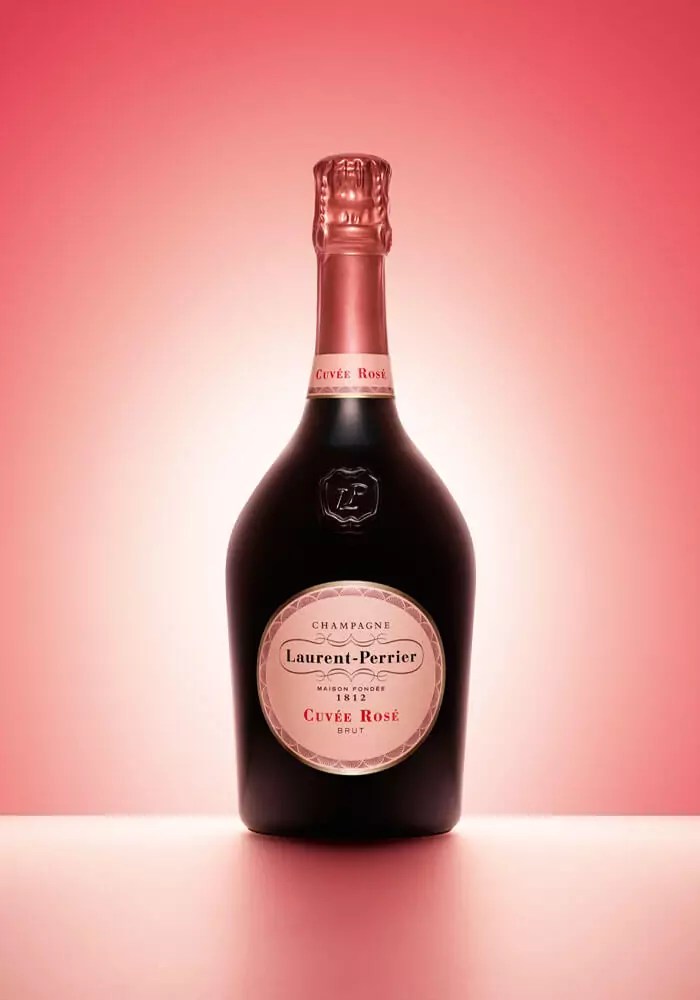
Laurent-Perrier takes this “intentional” process a step further, however. Back in the 1960s, the team at Laurent-Perrier, led by Bernard de Nonancourt, realized that cold stabilization during maceration, to prevent fermentation from starting, along with two daily pump-overs, would maximize flavor and texture extraction while preserving freshness and vivacity. After the 48-72 hour maceration, the grapes are then pressed and moved to stainless steel vats for fermentation. This is the same process used today and largely the reason that the Laurent-Perrier Cuvée Rosé has been the standard-bearer for rosé champagne since its introduction in 1968.
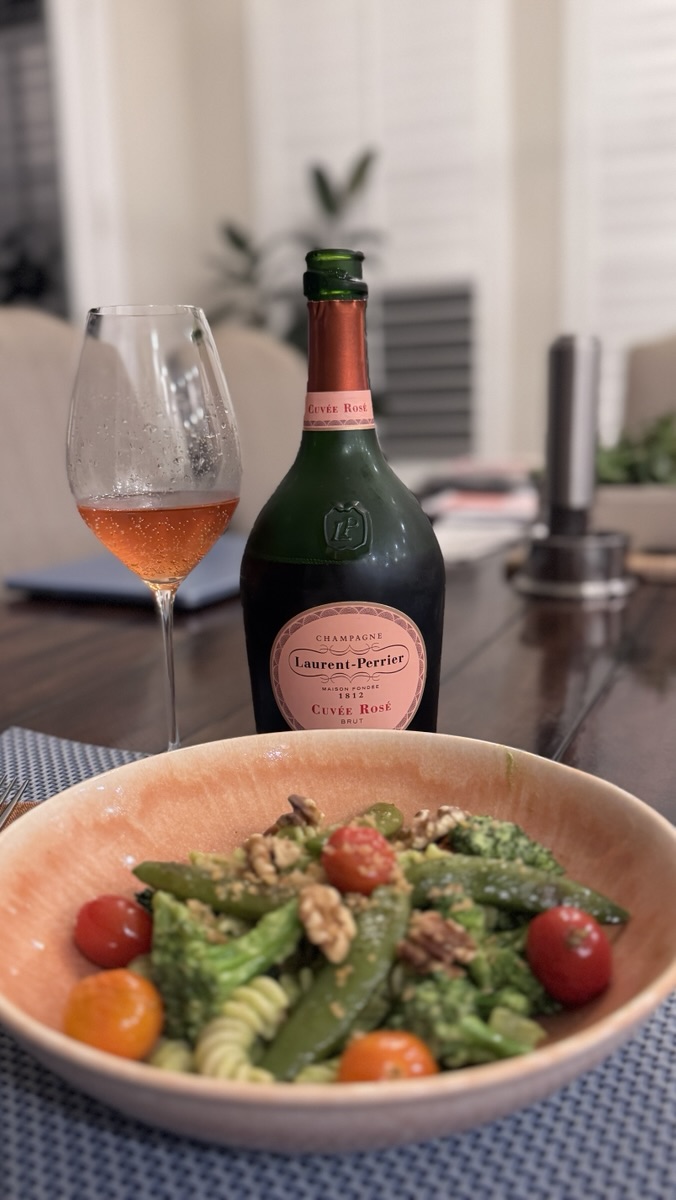
That was clear to me when I sat down with a bottle of it over dinner.
NV Laurent-Perrier Champagne Cuvée Rosé Brut, Champagne, France: Retail $90. Extremely Heavy Bottle (897g; 31.5oz). 100% Pinot Noir. When the kind folk at Laurent-Perrier (LP) dropped me a line a couple of weeks back to try a few of their wines, I truly thought it was some sort of cruel joke. But. No. Soon thereafter, several bottles showed up at my door, and I was soon elbow-deep in the history of the house and its unique approach to making champagne. While I was familiar with Laurent-Perrier, I had consumed far more of their Cuvée Rosé than any other wine in their stellar line-up. Why? It is undoubtedly due to the fact that, since its introduction in 1968, Laurent-Perrier Cuvée Rosé has been the standard for rosé in Champagne. Most rosé champagnes are made by adding a bit of still red wine into the blend until the desired hue is achieved. But unlike most other rosés from the region, LP does not add any still Pinot Noir to end at the desired level. No, the fruit is left to macerate in a stainless tank for several days in order to arrive at the flavor profile that defines LP Rosé. Rich and joyful on the nose, with a deep salmon color, one of the darkest rosés in Champagne, with intense cherry compote and a hint of yeast. The palate? Might I suggest allowing this wine to warm a bit, even as much as to cellar temperature (55°F or 12°C) or even beyond, which allows the intense flavor profile to fully emerge. Rich, tart cherry fruit abounds, with hints of that yeastiness lurking at every corner. But the real show-stopper here? The tartness. While the acidity is what defines all champagnes, here, the zinginess, while powerful, melds seamlessly into the whole. Whoa. And to top it off? This wine has one of the longest finishes I have experienced with a champagne. Outstanding 95 Points.






 the drunken cyclist
please don’t call it “bespoke”
LikeLike
I don’t. But others? Yeah, you’re not going to like it…
LikeLike
Pingback: The Savoir Faire of Laurent-Perrier: Non-Dosage | the drunken cyclist